Outdoor LED Display Buying Guide: How to Pick a Screen That Still Looks New in Year Five
Most outdoor LED display failures are not accidents. They are decisions made weeks before the steel structure goes up: a pixel pitch chosen by budget instead of viewing distance, a brightness figure copied from an indoor catalogue, a cabinet sealed to a rating that was never meant for rain and sun. This guide walks through the six decisions that separate a screen that keeps selling for you from one that keeps eating your service budget.
What this guide covers
Year One It Looked Stunning. Year Two It Looked Tired.
A screen goes up on a shopping mall facade. On handover day everyone takes photos: the colours are deep, the whites are clean, the image is sharp enough to stop pedestrians mid-step. Eighteen months later the owner calls and asks a question no one wants to hear — “why does it look washed out in daylight, and why is there a greenish patch on the left?”
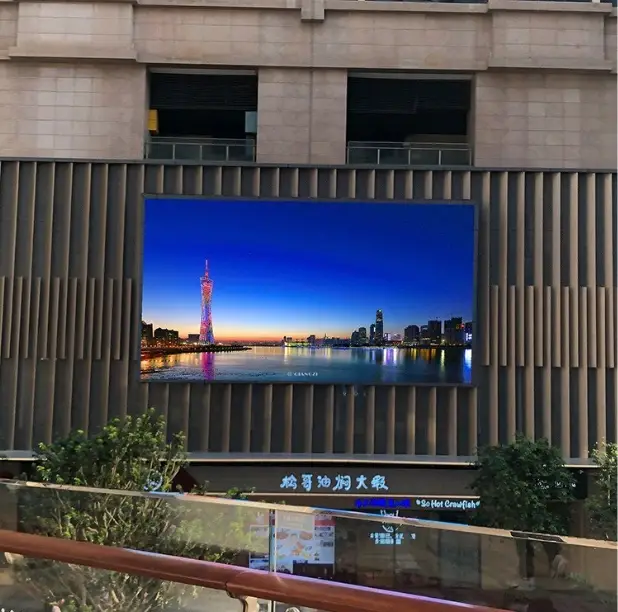
Nothing dramatic happened on that facade. Three quiet processes did the damage, and they all start on day one:
- Luminous decay. LED lamps lose output over time. A screen that leaves the factory at 6,500 nits and never gets recalibrated can drift well below its original brightness, and different colour lamps decay at different rates — which is exactly how a “greenish patch” is born.
- Ingress and moisture. Rain does not need a hole. It needs a gasket that ages, a screw seal that was overtightened at 2 a.m. on installation night, and one cold night of condensation.
- Thermal stress. An outdoor LED display in direct sun runs a brutal duty cycle. Undersized heat sinking and cheap power supplies turn a 10-year design life into a three-year replacement cycle.
The good news: every one of those failure modes is decided by specs you can check before you sign. Here is what to check, in the order you should check it.
What Actually Makes an Outdoor LED Display Different From an Indoor One
Indoor screens are designed for a controlled room. An outdoor LED display screen is designed for weather, sunlight, distance and vandalism. Four engineering numbers carry most of that difference — and all four are in the quotation if you know where to look.
Pixel pitch
Sets how close a viewer can stand before the image breaks into dots. It is the single biggest price driver in an outdoor LED display price quotation.
Brightness
Measured in nits. A high brightness outdoor LED display must beat direct sunlight and then dim itself smoothly at night, or it becomes a public nuisance.
IP rating
The published number for dust and water resistance. On outdoor cabinets, front and rear both matter — a single unsealed rear door is a warranty claim waiting to happen.
The six decisions, in the order that matters
Buyers usually start with price. Wrong end. Start with the site, and let the site dictate the spec — the sequence below is the one experienced outdoor LED display manufacturer teams run with their clients.
Skipping a step here does not save money. It moves the cost into maintenance.
Pixel Pitch: Pick It From the Sidewalk, Not From the Price List
Pixel pitch is the distance between the centres of two adjacent LED lamps, in millimetres. Smaller pitch means a sharper image and a much higher price; larger pitch means more square metres per dollar, as long as nobody stands too close.
The industry rule of thumb is simple: minimum comfortable viewing distance in metres is roughly one to one and a half times the pixel pitch in millimetres. Stand closer than that and you will start to see the individual lamps rather than the picture — which is exactly what pedestrians do in front of a mall.
| Pixel pitch | Comfortable viewing distance | Typical outdoor use |
|---|---|---|
| P4 – P5 | about 4 – 8 m | Retail window, station concourse, close-view plaza |
| P6 – P8 outdoor LED display | about 6 – 12 m | Mall facade, commercial building frontage, hotel entrance |
| P10 | about 10 – 20 m | Large building wall, roadside advertising, petrol station |
| P16 – P20 | 20 m and beyond | Highway outdoor digital billboard, stadium perimeter |
Brightness, Sealing and Image Quality: The Three Specs Buyers Under-Read
Brightness has to win against the sun — and behave at night
Sunlight on a facade can exceed 20,000 lux on a bright day. A screen that reads well in the showroom will look grey on that wall. Ask for the peak brightness figure and the automatic dimming range, because a screen with no dimming curve is either invisible at noon or offensive at midnight.
IP65 is the baseline — ask what is sealed, not just what is printed
An IP65 outdoor LED display cabinet resists dust and water jets. That is the entry ticket for permanent outdoor installation, not a premium feature. What separates suppliers is how the rating is achieved: gasket geometry, glue potting around module edges and connectors, cable glands, and whether the rear service door carries the same sealing as the front face.
Refresh rate and gray scale: invisible on site, obvious on camera
Refresh rate is how many times per second the screen redraws. Below roughly 1,920 Hz, phone cameras and broadcast cameras capture dark scan lines across the image. For any screen that will appear on television, on social media or in a live-streamed event, specify 3,840 Hz or higher. Pair it with 14–16 bit gray scale so gradients stay smooth at high brightness instead of banding into stripes.
Four structural layers that decide how long the screen lasts
SMD or COB? A quick note for outdoor projects
For most building-scale projects — an outdoor advertising LED display on a retail frontage, or a large outdoor LED video wall seen from 15 metres away — SMD is the mainstream, cost-efficient choice. A COB outdoor LED display bonds the lamps directly to the board and covers them with a protective layer, which raises impact and moisture resistance and removes the yellowing mask problem entirely. If your screen sits at ground level, faces salt air, or is expected to last a decade with minimal touch, COB is worth the premium. If it is high on a wall and viewed from a distance, a well-specified SMD screen is usually the smarter buy.
The Real Cost of an Outdoor LED Display Is the Next Five Years
Price is the smallest part of the conversation. An outdoor screen consumes power every night, needs cleaning and inspection, and eventually needs modules replaced. Compare two quotes on purchase price alone and you will choose the more expensive screen over its lifetime.
| Five-year cost line | Lowest-price build | Specified build |
|---|---|---|
| Purchase price | 100 | 118 |
| Energy consumption | 100 | 88 |
| Service visits | 100 | 45 |
| Modules replaced | 100 | 30 |
| Unscheduled downtime | 100 | 35 |
| Five-year total | 100 | about 82 |
How will you reach a broken module?
This one question predicts your downtime better than any spec sheet. Front service lets a technician replace a module from the street side, with no scaffolding and no crane. Rear service is cheaper per cabinet, but only works if you designed a permanent walkway behind the screen — and on a facade, you probably did not. Confirm the answer in writing, and confirm that spare modules will be held in stock, not manufactured to order.
What to ask before you sign
- Brightness after 3,000 hours — not just at day zero.
- The guaranteed dead-pixel rate and the warranty period for it.
- The ingress protection test report for the exact cabinet you are buying.
- Power consumption at average content brightness, in W/m².
- Lead time for a replacement module, and whether remote monitoring and recalibration are supported.
- Who performs colour calibration on site after installation, and what it costs.
A serious outdoor LED display manufacturer answers all six in writing before you ask twice.
Key Takeaways: Outdoor LED Display Checklist
If you remember nothing else from this guide, keep this table. It is the whole article compressed into one screen.
| Item | What to remember |
|---|---|
| Pixel pitch | Minimum comfortable viewing distance in metres is roughly 1–1.5 times the pixel pitch in millimetres. Choose it from where people will actually stand. |
| Brightness | Facade applications typically need 6,000 nits and up; sun-facing walls more; highway billboards around 8,000 nits. Always paired with automatic dimming. |
| IP rating | IP65 front and rear is the outdoor baseline. Ask how the sealing is built, not just what number is printed. |
| Refresh rate | 3,840 Hz or higher if cameras will ever film the screen. Pair with 14–16 bit gray scale. |
| Serviceability | Front service access and stocked spare modules are worth more than a small price discount. |
| Lifetime cost | Energy, service visits and downtime usually overtake the purchase price within five years. |
| Calibration | Schedule on-site brightness and colour calibration at handover and once more in year two. This is what prevents the “greenish patch”. |
Frequently Asked Questions
What pixel pitch do I need for an outdoor LED display?
Start from the shortest distance a viewer will stand. As a rule of thumb, the minimum comfortable viewing distance in metres is about 1 to 1.5 times the pixel pitch in millimetres, so a P8 outdoor LED display suits viewing from roughly 8–12 m and a P10 suits 10–20 m. If the audience passes within a few metres, a P4–P5 screen is the practical minimum.
How bright should an outdoor LED display be?
Building facades typically use 6,000 nits and above, roadside advertising around 8,000 nits, and walls in direct sun can call for 10,000 nits. Brightness alone is not enough: automatic dimming is what keeps the screen readable at noon and comfortable at midnight.
What does IP65 mean on an outdoor LED display?
IP65 means the cabinet is dust-tight and protected against low-pressure water jets from any direction, which is the normal baseline for permanent outdoor installation. It is a rating for the assembled cabinet, so ask for the test report covering the exact model and confirm the rear service door is sealed to the same standard as the front.
How long does an outdoor LED display last?
Well-built cabinets are commonly engineered for a service life of about 100,000 hours of LED operation, roughly ten years of typical use. Real-world life is decided by sealing quality, heat management, power supply grade and whether the screen is calibrated and cleaned on schedule.
Is COB better than SMD for outdoor LED displays?
COB offers better impact and moisture protection and avoids mask yellowing, which suits ground-level, coastal or long-life installations. SMD remains the more cost-effective choice for large facade and billboard screens viewed from a distance. The right answer depends on mounting height, climate and service expectations.
Send Us Your Site Photo and Viewing Distance
Tell us where the screen goes and how far away people will stand. We will come back with a recommended pixel pitch, brightness target, cabinet and IP rating — plus a budget range for your outdoor LED display, usually within one working day.
Request a Quote Download the Spec ChecklistThis article is original technical editorial. All figures are typical industry ranges given for planning purposes and are not a specification or a quotation; final values depend on the project specification and site measurements. Product names and standards are referenced for identification only.