How to Choose an LED Display Company: 7 Checks Before You Pay a Deposit
Any supplier can make a screen look stunning on day one in a shopping mall atrium. The real separation happens around day 900. This guide skips the spec-sheet theatre and answers one question instead: is the led display company in front of you actually building the product — or just reselling it?
What's inside
- Why the same screen looks tired after two years
- A real led display manufacturer vs. a trading-style led display supplier
- Five checks that keep risk on the supplier's side of the table
- Indoor or outdoor? Settle the scene before you settle the factory
- Why COB LED display is displacing SMD
- The hidden cost curve of a cheap led display price
- Key takeaways
- FAQ
1. Why the same screen looks tired after two years
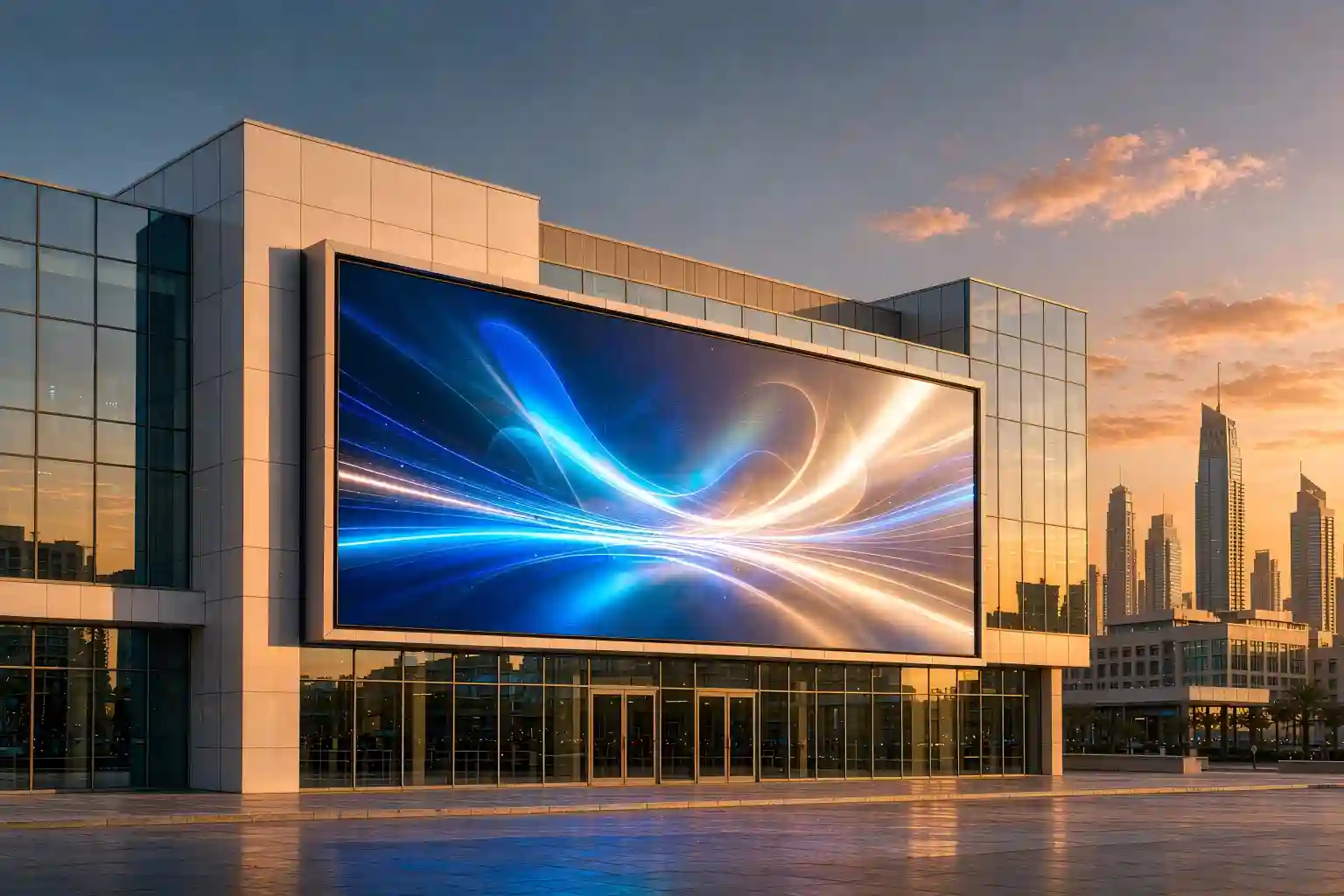
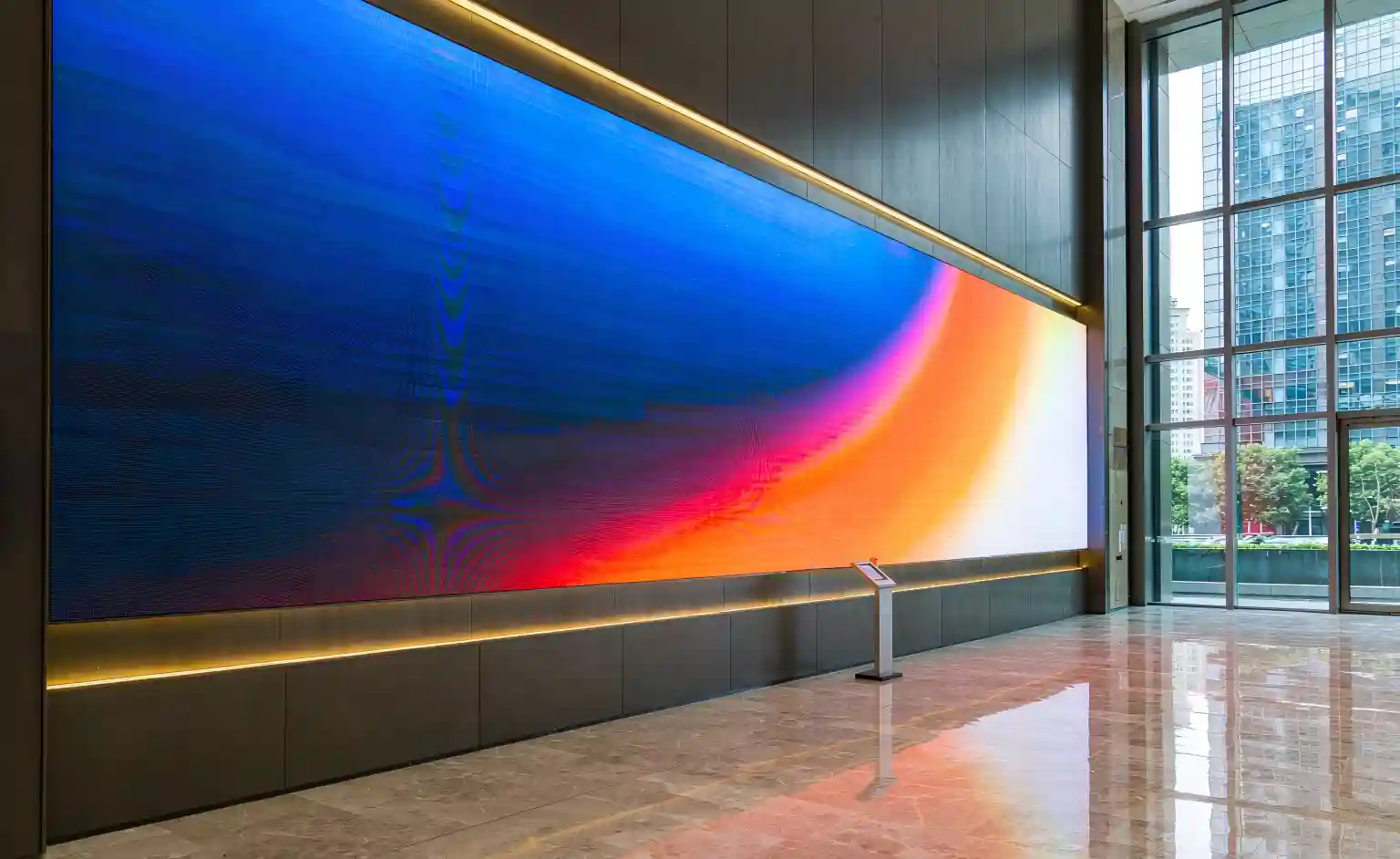
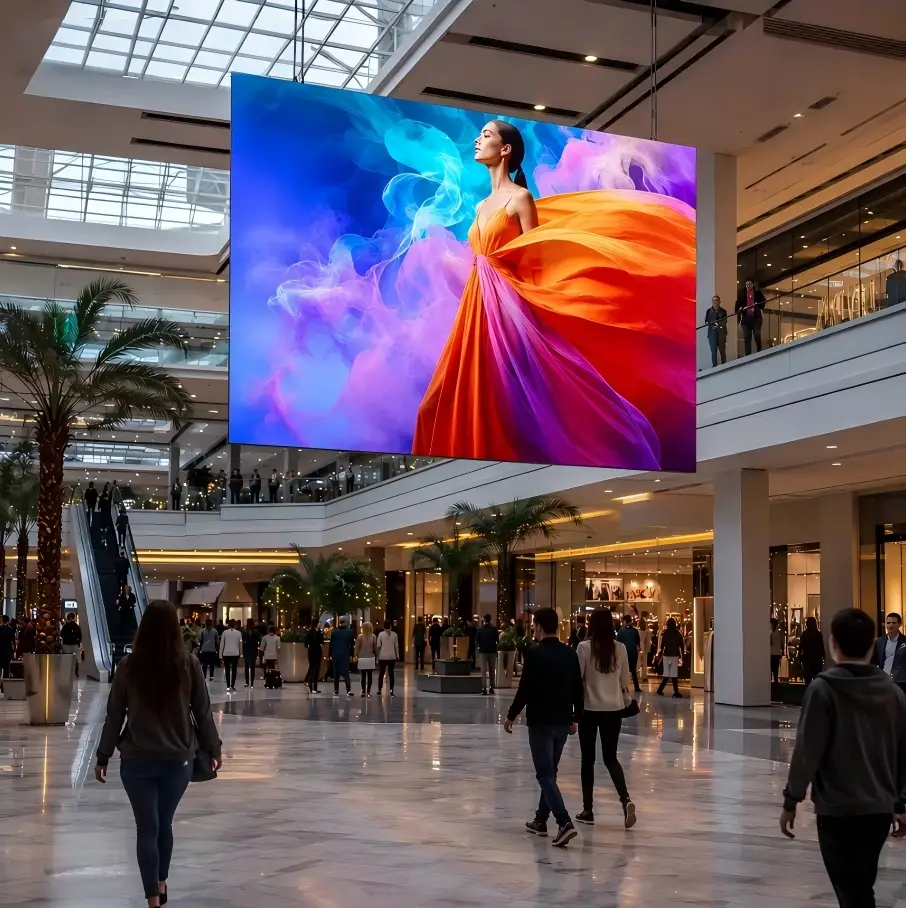
A suspended led video wall like the one above is the centrepiece of many retail projects. On opening day the image is bright, saturated and flawless — the client is happy, the contractor signs off, everyone moves on. Come back two years later and the story has changed: patchy blocks of uneven brightness, a pinkish cast creeping into the corners, a few dark modules, and an overall luminance drop of roughly 30%.
Almost none of these failures are bad luck. They were locked in the day the supplier was chosen. Three patterns account for most of them:
01Uneven brightness decay
Mixed LED batches and no point-by-point calibration produce visible colour blocks within six months. Software cannot fix this — the modules have to be swapped.
02Power supply and receiving card failures
Overstated power ratings and copy-pasted thermal design mean supplies fail in batches during summer heat, showing up as dark blocks, scrambled images and flicker.
03Discontinued spare parts
A trading-style supplier builds nothing itself. Two years on, the cabinet and module are out of production and one dead LED becomes a full-screen replacement.
Put simply: a led display price that is 15% lower can translate into 60% extra maintenance spend within three years. That is why experienced buyers inspect the factory before they read the quotation.
2. A real led display manufacturer vs. a trading-style led display supplier
Hundreds of companies call themselves an led display company, but structurally there are only two kinds: those that own production lines, mechanical design and ageing facilities — and those that take the order and outsource it. The quotation looks identical. The project lifecycle does not.
| Dimension | led display manufacturer with own lines | Pure trading-style led display supplier |
|---|---|---|
| Lead time | Owns the schedule, commits to a delivery window, can re-sequence for large projects | Waits on a third party; slips badly in peak season with no recourse |
| Mechanical design | Draws cabinet, thermal path and power redundancy in-house; handles bespoke and suspended structures | Limited to off-the-shelf tooling; asks you to change the requirement instead |
| Failure diagnosis | Traces to a specific process step and batch, issues a root-cause report | Only relays what "the factory said"; parts get swapped, the fault returns |
| Spare parts | Keeps a 3–5 year spares inventory on key models, supports board-level repair | No stock, sources on the open market, frequent model gaps |
| Quote structure | Line-itemised: LEDs, driver ICs, PSU, cabinet, freight, calibration | One lump sum; the discount looks generous because the cuts are invisible |
A test that works every time: ask for a "de-scoping schedule" — if the budget were cut by 20%, which components would change? Suppliers who can break it down component by component usually own the lines. Those who will only discuss the total price usually do not.
3. Five checks that keep risk on the supplier's side of the table
Run these in order before signing. Do not reshuffle them: verify capacity first, then design, then after-sales — because the further down the list you go, the harder it becomes to fix a gap with contract clauses.
Check 1 — Production: ask for camera, date and part number
Request photos or a short video of the SMT machines, reflow ovens and ageing racks, with the current week's date or a part-number label visible in frame. A led display company that can produce this on request is almost always the same organisation as the led display manufacturer behind it. Deflection here is a downgrade signal.
Check 2 — Design: ask how they calculated the thermal load
A genuine led display solutions provider will immediately describe the heat path, the power headroom (30% or more is a reasonable benchmark) and whether cabinets are front- or rear-serviceable. "That's how everyone does it" is not an answer.
Check 3 — Calibration: point-by-point is the floor, not a bonus
Point-by-point calibration determines luminance and chroma uniformity across the wall. Ask for the actual calibration report and confirm it covers the full screen at the factory, not just module binning. Without it, the front row of any audience will see the difference.
Check 4 — Certification: verifiable, not decorative
CE and RoHS cover the EU, FCC covers the US, and markets such as Saudi Arabia require local schemes like SASO. The advantage of a China led display company is precisely this supply-chain and certification depth — if they cannot give you certificate numbers you can verify online, they will not be much help at customs either.
Check 5 — After-sales: get the SLA into the contract
Four questions matter: how many years of spares are held, what the response time is, whether remote diagnostics are supported, and what the spare-parts ratio is (3%–5% shipped with the screen is common practice). Answer those and your led display screen becomes an operable asset rather than a liability.
4. Indoor or outdoor? Settle the scene before you settle the factory
Lock your requirement down before you shop. The same led display company is often stronger in one arena than the other: indoor led display is judged on uniformity and viewing quality, outdoor led display on ingress protection and structural engineering.
| Selection factor | indoor led display | outdoor led display |
|---|---|---|
| Typical pixel pitch | P1.2 – P2.5 (close viewing, fine detail) | P4 – P10 (long viewing distance, budget-aware) |
| Brightness | 600 – 800 nits (glare control) | 5000 – 6500 nits (direct sunlight) |
| Ingress protection | IP31 or better, thermal design critical | IP65 and above, sealing and drainage critical |
| Main risk | Uniformity, colour shift, seam flatness | Water ingress, wind loading, thermal derating |
| What to vet in the supplier | Calibration and ageing capability | Structural fabrication and anti-corrosion process |
5. Why COB LED display is displacing SMD
If you build close-view installations — malls, boardrooms, showrooms — you will have been offered COB LED display in the last two years. The difference is packaging: instead of individual LEDs soldered bare to the board surface, the whole array sits under a resin layer.
COBFully encapsulated, flat surface
Resistant to moisture, impact and static, and cleanable on site. No visible granularity at close range — the preferred choice for premium led video wall and indoor deployments.
SMDExposed individual LEDs
Lower cost and a mature supply chain, but vulnerable to humidity and abrasion, with visible granularity at short viewing distances.
For buyers this means three things. First, lower operating cost — COB screens fail noticeably less often in humid, high-traffic environments. Second, a visual premium — at the same pixel pitch, COB delivers a more convincing close-range image for flagship retail. Third, a higher barrier to entry: COB demands tighter placement and encapsulation processes, so far fewer manufacturers can run it reliably at volume than can build SMD.
So when you ask an led display company for a COB quotation, ask one follow-up question: "Is your COB line in-house or outsourced?" The answer usually tells you who you are actually talking to.
6. The hidden cost curve of a cheap led display price
Stretch the timeline to five years and the cheap option and the qualified option cross over. The chart below illustrates a common industry pattern: the horizontal axis is years in service, the vertical axis is a cumulative cost index (lower is better).
| Hidden cost | Root cause | When it shows up |
|---|---|---|
| On-site rework | Cabinet seams out of tolerance, poor flatness | Installation phase — labour and rigging double |
| Service travel | No remote diagnostics, engineers must fly out | Continuously from year 1 |
| Emergency spares | No local spares stock, air freight only | Years 1–2; a single shipment can reach 3%–8% of screen value |
| Full replacement | Model discontinued, batch colour variance too wide | From year 3, and irreversible |
| Reputation damage | Client escalations, retention held, future tenders lost | Anytime — hardest to quantify, most expensive of all |
Which is why the principle is simple: choosing an led display company is really choosing your operational certainty for the next five years. The unit price difference is a one-off. The operational difference compounds.
7. Key takeaways
| Takeaway | Remember it in one line |
|---|---|
| Identify the entity | An led display manufacturer with lines will itemise the quote; a trading-style led display supplier only gives a total. |
| Verify the line | Ask for SMT machines, reflow ovens and ageing racks with the current week visible. |
| Test the design | Only a supplier that can explain the thermal path and ≥30% power headroom is a real led display solutions provider. |
| Calibration is the floor | Point-by-point calibration plus full-screen factory ageing is the minimum bar for uniformity. |
| Match the scene | indoor led display is about uniformity; outdoor led display is about ingress rating and structure. Settle the scene before the price. |
| Follow the technology | COB LED display is displacing SMD in close-view, humid, high-traffic venues. |
| Cost realistically | led display price only wins the first two years. After year 3, operating cost decides. |
| Contract non-negotiables | Spares duration, response SLA, remote diagnostics, spare-parts ratio — all four, in writing. |
| Supplier profile | A certified, reference-checkable China led display company is usually more controllable than a broker found at short notice. |
8. FAQ
Q1: How do I tell whether an led display company is a real factory or a trader?
Ask for dated production footage, insist on a component-level quote (LEDs, driver ICs, PSU, cabinet, freight) and ask how many years of spare parts they hold. If two of those three answers are vague, treat them as a trading supplier.
Q2: What exactly is cut when an led display price is 20% lower?
Usually power headroom, driver IC brand, LED batch consistency, cabinet wall thickness and anti-corrosion treatment. None of it is visible in the first three months. All of it shows up in years 2–3 as uneven decay, batch power failures and discontinued spares.
Q3: Should every indoor project use a COB LED display?
Not necessarily. Below P2.5, at short viewing distance, or in humid and high-traffic venues, COB LED display wins clearly on long-term failure rate and image quality. For budget-sensitive projects viewed from further away, a well-built SMD solution remains viable.
Q4: Which certifications should the manufacturer provide for export projects?
CE and RoHS for the EU, FCC for the US, and local schemes such as SASO for parts of the Middle East. Put "certificate numbers must be publicly verifiable" in the contract and require customs documentation support. Certified China led display company partners are typically far easier to work with here than intermediaries.
Q5: What should I check when accepting an led video wall installation?
Four things: flatness and seam quality on a full white field, colour uniformity at low grey levels, the measured data in the point-by-point calibration report, and whether front or rear service access actually works. Make "72 hours continuous operation without anomaly" a contractual acceptance condition.
Turn the checklist into a spec you can compare
If you are shortlisting an led display company for a mall, showroom, transit hub or outdoor project, send us the scene and we will come back with a comparable proposal covering:
- Installation scene and viewing distance → recommended pixel pitch and brightness
- Screen dimensions and mounting method (suspended / pole / wall-mounted)
- Three configurations — indoor led display, outdoor led display and COB LED display — with price bands
- Full quotation including spare-parts ratio, warranty term and response SLA
Original technical write-up. Brightness, pixel pitch, spare-parts ratios and cost indices shown here are illustrative industry ranges used to explain selection logic; actual values depend on your project specification and on-site measurements.