CIOE 2026 Takeaways: 5 Signals COB LED Displays Are Going Mainstream
The 27th China International Optoelectronic Exposition (CIOE 2026) ran September 9–11 at the Shenzhen World Exhibition & Convention Center. Here's an LED engineer's read on the five signals that matter — and the answer to every buyer's biggest question: will COB be obsolete in three years?
1. A 320,000 m² Mirror of the Industry
Every September, the CIOE show in Shenzhen is the LED display industry's most honest mirror — manufacturers put their newest production lines, newest processes, and newest samples on the floor. You don't see slide decks; you see hardware.
This year the mirror was bigger than ever: CIOE 2026 co-located with the IICIE integrated-circuit expo and the elexcon electronics show, for a combined 320,000 m², 5,000+ exhibiting companies, and over 240,000 professional visitors across eight themed expos covering the full optoelectronics chain.
Walk the new display hall booth by booth, as we did, and one conclusion stands out: the COB LED display has graduated from "premium option" to "commercial default." But that's not the only signal. Here are the five trends we took away from the floor.
2. Five Technology Signals: From COB to Micro LED
Signal 1: COB is now the mainstream indoor display solution
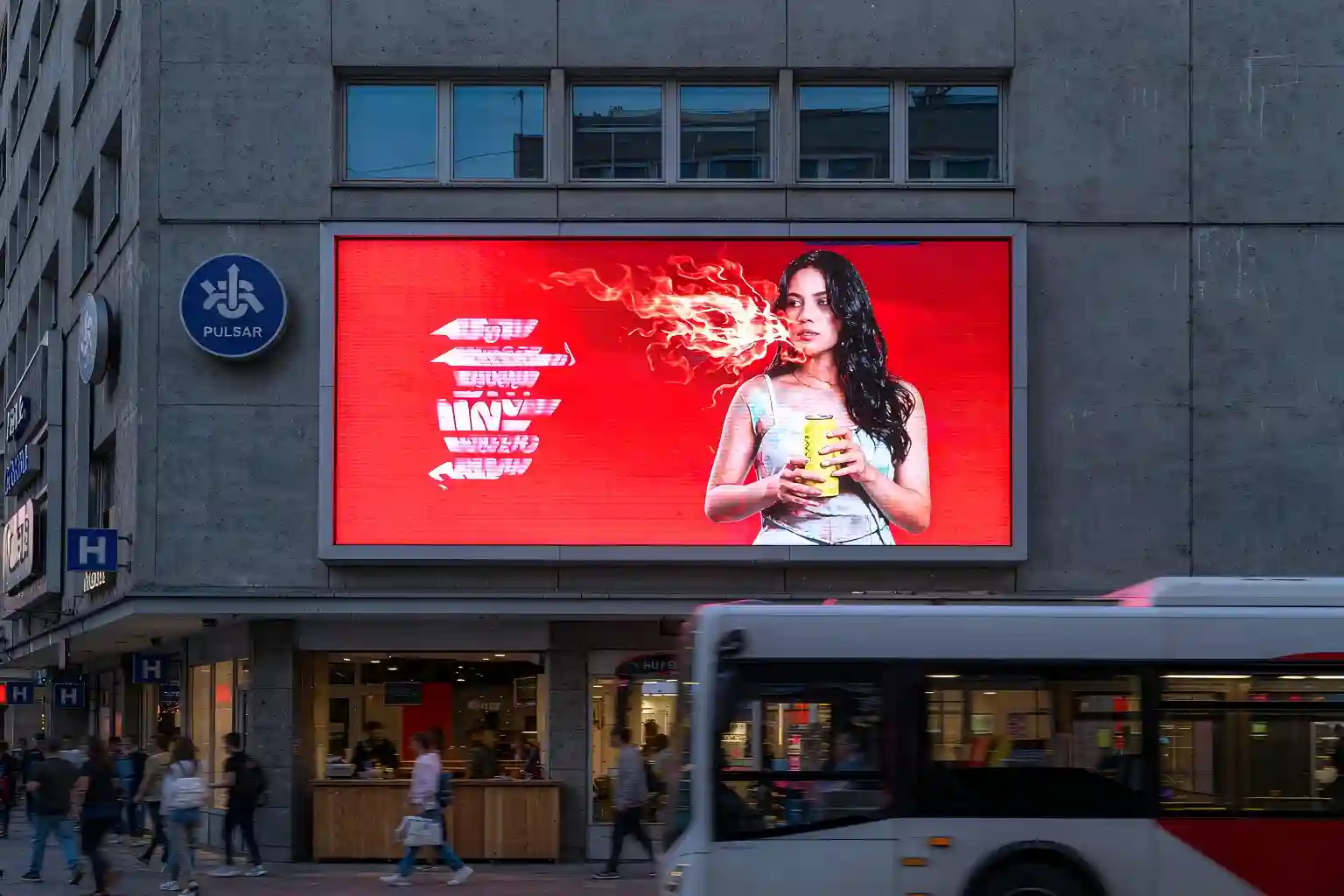
At this year's show, the flagship walls from leading manufacturers were almost uniformly COB LED displays. Chip-on-Board packaging — with its high protection, low reflection, and high contrast — has fully penetrated indoor fine-pitch and semi-outdoor applications.
The bigger story is the arrival of the "cold screen": through fully flip-chip LEDs + common-cathode driving + integrated thermal design, the newest COB products cut annual power consumption by more than 40% versus conventional SMD screens, while easing the classic after-sales headaches of black screens, glare, and dust-induced shorts. When multiple exhibitors print power-comparison numbers at the top of their booth graphics, it means the industry has moved from competing on specs to competing on energy — the signature of a maturing technology.
Signal 2: MIP is claiming the sub-P0.9 ultra-fine-pitch market
If COB owns the mainstream P1.0–P1.5 commercial market, MIP (micro-scale device-in-package) is aimed at the extreme end of the pitch range: chip-level modular packaging simplifies production, current products reach pitches as fine as 0.4 mm, and the target applications are XR virtual production, premium cinema, and 100-inch-plus home theater. Dedicated MIP production lines are being built, with a volume-delivery window opening in the second half of 2026.
Signal 3: Glass-based Micro LED enters its mass-production era
The most "generational" signal on the floor: glass substrates replacing conventional PCBs. Glass offers wiring precision down to 12 μm and superior thermal stability, and hybrid mass-transfer processes have passed 99.99% yield. BOE, Ledman, and others keep expanding glass-based lines, while Samsung has pushed 130-inch Micro LED commercial walls overseas. The target applications — AR near-eye displays, automotive HUDs, premium transparent showcases — make this the "next generation," not "this generation," for mainstream display buyers.
Signal 4: Quantum dot COB opens a new color-gamut track
At booths like Sapphire's, the fusion of quantum dots (QD) with COB/MIP was a visible new theme: a flagship QD Plus series alongside QD MIP and QD Lite modules. QD materials give COB LED displays a wider color gamut and more accurate color — the next upgrade path for broadcast and color-critical conference settings.
Signal 5: AI is rewriting the product logic of displays
"Photonics + AI" was the headline theme of CIOE 2026. For LED displays specifically, AI has moved beyond concept: display-control systems are integrating large models, turning screens from one-way playback terminals into nodes that can sense, compute, and self-maintain. For integrators the implication is concrete — remote intelligent inspection, fault prediction, and automated content generation all reduce total cost of ownership.
3. What It Means for Buyers and Integrators
Back to the practical question every buyer asks: if I invest in COB LED displays today, will they be obsolete in three years? Our read: no — but your selection logic should be updated.
First, COB is in its scale-dividend phase — China holds over 65% of global LED display capacity, and the scale of COB production lines is rapidly amortizing costs, so the same budget buys better specs every quarter. Second, MIP and glass-based Micro LED fill the sub-P0.9 and specialty segments; they coexist in layers with COB rather than replacing it. Third, AI-driven operations are becoming a differentiator — put "intelligent O&M interface" on your evaluation checklist now.
4. Key Takeaways
| Technology | Pitch range | Core strengths | Typical applications |
|---|---|---|---|
| COB LED display | P0.9 – P1.5+ | High protection, low reflection, high contrast; flip-chip + common cathode, cold screen saves 40%+ power | Boardrooms, control rooms, retail, semi-outdoor |
| MIP | Sub-P0.9 (down to 0.4mm) | Chip-level packaging, modular production, extreme pitch | XR virtual production, premium cinema, home theater walls |
| Glass-based Micro LED | Ultra-fine / specialty form factors | 12μm wiring precision, 99.99% mass-transfer yield, ultra brightness in a thin form | AR near-eye, automotive HUD, transparent showcases |
| Quantum dot COB | Layered onto COB/MIP | Wider color gamut, more accurate color | Broadcast, color-critical conference settings |
5. Frequently Asked Questions
Will COB LED displays be made obsolete by MIP or Micro LED anytime soon?
No. MIP targets the sub-P0.9 ultra-fine segment and glass-based Micro LED targets AR and automotive-type applications — they coexist with COB in layers rather than replacing it. In the mainstream P0.9-and-above commercial market, COB is in its mature, scaled phase and the cost curve is still improving.
What is a "cold screen," and why does it matter for my project?
A cold screen is a new-generation COB product that combines fully flip-chip LEDs, common-cathode driving, and integrated thermal design to cut operating temperature and total power draw — over 40% annual energy savings versus conventional SMD, plus lower risk of black screens, glare, and dust shorts. That translates directly into lower electricity bills and fewer after-sales callouts.
Is after-sales support harder for COB on overseas export projects?
Quite the opposite. The chip-on-board structure is more robust than discrete-device packaging — better resistance to shock, moisture, and dust, which means lower failure rates in transit and in long-term operation. Combined with factory calibration backups and remote intelligent O&M, the total after-sales cost of overseas COB projects is well controlled.
Is quantum dot COB worth waiting for?
Depends on the application. Broadcast-grade color and premium brand showrooms should watch it closely and design in an upgrade path. For standard commercial and monitoring installations, current COB color performance is already sufficient — there's no reason to delay a project.
Planning a COB LED display procurement project?
We supply cold-screen-class COB products with factory point-by-point calibration and full technical support for overseas projects — helping you lock in the best specs and pricing during the scale-dividend window.
Get a Technical Proposal & Quote