Dubai outdoor display · Buyer's & compliance guide
LED Sign Board in Dubai: How to Choose a Display Built for 50°C Heat and Municipality Approval
In Dubai, the toughest opponent of an LED sign board is rarely the paperwork — it is 50°C heat, near-100,000-lux sunlight, sand and salt air. This guide splits "buying a screen" into four questions — climate, permits, specification and cost — and answers each one with concrete, checkable criteria.
1. Why LED sign boards in Dubai start to look washed out in year two
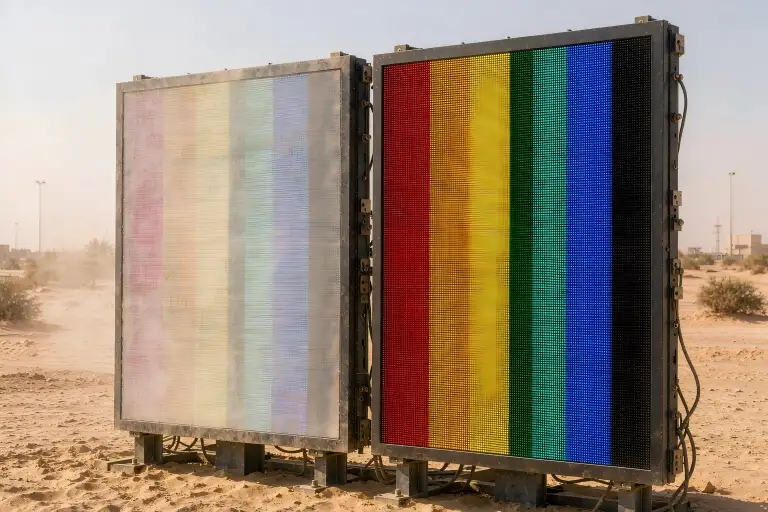
We have seen this opening many times: a new store in Dubai, the sign board blazing bright on day one, everybody happy. Then the second summer arrives and the picture looks like it is behind frosted glass — colours go grey, faint dark lines appear, and while the screen looks fine at night, daytime is exactly when the business needs it most. Open the cabinet and you find LED lumen decay, bulged power supplies, a UV-powdered mask and vents clogged with fine sand.
The screen is usually not "bad" — the specification is simply mismatched to the climate. A large share of outdoor displays on the market are designed for temperate climates: around 5,000 nits, IP65 on the front, fan-cooled cabinets. That configuration works in Europe. Move it to Dubai and three things hit it at once —
The rest of this guide unpacks those three questions — plus the permit process that decides whether your screen ever gets switched on.
2. Three extra tests Dubai sets for every LED sign board
Sunlight & glare
Under midday sun approaching 100,000 lux, anything below 5,500–6,500 nits is effectively blind in daylight; south-facing, fully exposed sites should aim for 8,000 nits or more.
Photosensor auto-dimming is standard: full output by day, stepped down at night — it saves power and satisfies glare and light-pollution limits.
Heat & cooling
At 45–50°C ambient, the inside of the cabinet runs even hotter. Read the operating temperature range (−20°C to +60°C), the power-supply derating curve at high temperature, and IC junction-temperature control.
A fully sealed, fanless design survives sand far better than "fans plus dust filters". Air-conditioned cabinets do cool, but add power draw and maintenance points.
Dust, salt & humidity
Coastal sites (Jumeirah, Dubai Marina and similar) suffer visible salt corrosion — IP66 is the safer choice; inland dust tests the sealing, not the airflow.
Check the details: conformal coating, stainless fasteners, rear service rating of IP54 or better, and all cables and connectors fully concealed.
3. Permits first: who approves, how long, and why applications bounce
In Dubai, an outdoor LED sign board falls under "approve first, install later". Installing without a permit risks fines and a removal order at your own cost — and an open violation can hold up other approvals for the same property, including trade-licence renewal.
| Authority | What it covers | Typical timeline* |
|---|---|---|
| Dubai Municipality (DM) | Façade, rooftop and shopfront signs in most of the city | ~4–6 weeks |
| RTA | Road-facing screens visible from public roads | ~3–6 weeks |
| Trakhees / free-zone authority | Plots inside JAFZA, Dubai South and similar zones | ~2–5 weeks |
| DDA | Creative-cluster and other free-zone plots | ~2–5 weeks |
| DEWA | Electrical connection NOC — mandatory for illuminated signs | Runs in parallel |
* Typical ranges; always confirm current requirements with the authority. Applying to DM and RTA in parallel usually totals 6–10 weeks.
The six most common reasons applications get rejected
- Technical drawings in imperial units — the Dubai Universal Design Code accepts metric only
- Missing Arabic text on commercial signs, or Arabic rendered smaller than English
- Sign name that does not match the trade licence word for word
- Missing landlord NOC, or an NOC on informal letterhead without an authorised signature
- Structural calculations without a licensed engineer's stamp (required for most signs above 2.5 m)
- Brightness documentation that lists only peak nits without confirming photosensor auto-dimming
4. Spec and cost: spend where the eye can actually see it
1. Pixel pitch is set by viewing distance, not by budget
| Pitch | Optimal distance | Typical application |
|---|---|---|
| P2.5–P4 | 3–8 m | Shopfront sign boards, lobbies, showcases |
| P5–P6 | 8–20 m | Building podiums, mall entrances |
| P8 | 15–35 m | Roadside totems, large façades |
| P10 | 25–60 m | Highways, rooftop signage |
2. Compare lifetime cost, not price per square metre
Most screens in Dubai run 14–18 hours a day, so electricity and maintenance are the long-term costs: outdoor displays commonly average 300–400 W/m² with higher peaks. Between two screens at the same price, a common-cathode or high-efficiency design can save more in electricity over two to three years than the initial price gap (typical ranges, indicative). Rated life is around 100,000 hours — and how well the cabinet manages heat decides which year large-scale lumen decay begins.
3. Ask your supplier for these 8 things
- High-temperature ageing and salt-spray test reports (not just an IP rating)
- Real brightness after high-temperature derating, not laboratory peak nits
- Operating temperature range and measured cabinet temperature rise
- LED brand and batch, plus a decay curve (e.g. brightness maintenance at 50,000 hours)
- A list of power-supply and receiving-card brands, with locally replaceable models
- Confirmation of front vs. rear service access (site space decides)
- Bilingual Arabic–English font library and CMS (test Arabic right-to-left rendering)
- Spare-parts supply and remote-support commitments, including response time
A quotation worth comparing breaks out the screen, steel structure, control and installation, permit support, and sea freight with customs as separate lines. A single "price per square metre, all-in" number usually grows extra items halfway through the project.
5. Key takeaways
| Topic | One-line conclusion |
|---|---|
| Climate | 45–50°C heat + near-100,000-lux sun + dust and salt air define the Dubai baseline |
| Brightness | 5,500–6,500 nits minimum for daylight readability, 8,000+ on south-facing sites, always with auto-dimming |
| Protection | IP65 minimum, IP66 near the coast; fully sealed fanless beats fans + filters |
| Thermals | Judge the operating range, high-temp derating and IC junction temperature — not peak brightness |
| Permits | DM / RTA / Trakhees + DEWA NOC; DM + RTA in parallel typically 6–10 weeks |
| Arabic | Commercial signs are bilingual, with Arabic no smaller than English |
| Pitch | Viewing distance sets the pixel pitch: measure the distance first, then choose |
| Cost | Compare lifetime cost — power + maintenance + downtime — not price per square metre |
Frequently asked questions
How bright does an outdoor LED sign board in Dubai need to be?
For daylight readability, start at 5,500–6,500 nits; south-facing or fully sun-exposed sites should aim for 8,000 nits or more, always with photosensor auto-dimming that steps brightness down at night to balance power use and glare limits. These are typical industry ranges — confirm with on-site measurement and permit requirements.
Which approvals does an LED sign board in Dubai need, and how long do they take?
The authority depends on the plot: Dubai Municipality for most of the city, RTA for road-facing screens, Trakhees or the relevant free-zone authority inside zones — plus a DEWA NOC for any illuminated sign. DM takes about 4–6 weeks, RTA 3–6 weeks, and running both in parallel typically totals 6–10 weeks; free zones run 2–5 weeks (typical ranges).
How is the price of an LED sign board in Dubai calculated?
Pricing is usually quoted per square metre and swings widely with pixel pitch, brightness, structure, installation and permit support. Imported projects should also budget sea freight, customs, local steelwork and electrical connection. Ask suppliers for itemised quotations, then compare lifetime cost rather than unit price alone.
Does signage in Dubai have to include Arabic text?
Commercial signage generally must be bilingual Arabic and English, with Arabic no smaller than English. The same applies to text played on LED screens — present it in both languages and follow the current interpretation of your local authority.
What else should we check when importing an LED screen from China to Dubai?
Confirm 220V/50Hz power and local electrical compliance, ship high-temperature and salt-spray test reports with the goods, verify CE and UAE local certification requirements, and lock in spares and remote support; the control system must handle Arabic–English bilingual content with tested right-to-left rendering. Confirm the exact certification list with your local import agent.
Turn this checklist into your project spec
Tell us the site orientation, key viewing distance and screen size, and we will send back an itemised specification and pitch recommendation engineered for Dubai's climate and permit process.
Get a Dubai project specification