Shenzhen LED Display Manufacture: The Story Behind a Supermarket Wall That Never Turns Off
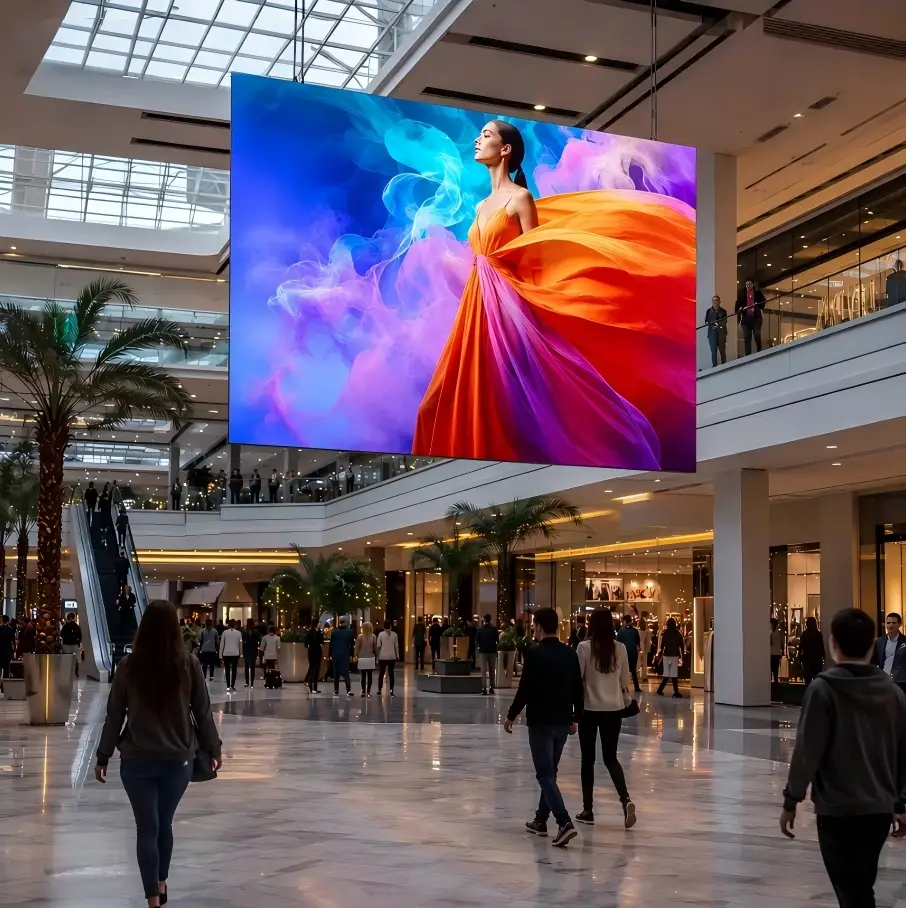
Sixteen hours a day, a ten-metre indoor LED display hangs above the produce aisle of a supermarket chain. Shoppers look up and see tomatoes and bell peppers. The procurement manager sees three other things: who built it, how it was calibrated, and whether it will still look clean in year three instead of developing a patchwork of colour shifts. This article takes that one retail screen and unpacks Shenzhen LED display manufacture into a supply chain you can inspect, step by step.
Why the screen hangs above the produce aisle
Produce aisles are the hardest lighting environment in a store. Chiller glass throws reflections, ceiling spots run warm, and the goods themselves are saturated in colour. An LED display mounted there is judged immediately: shift the hue a little and the whole screen looks dirty, however bright it is.
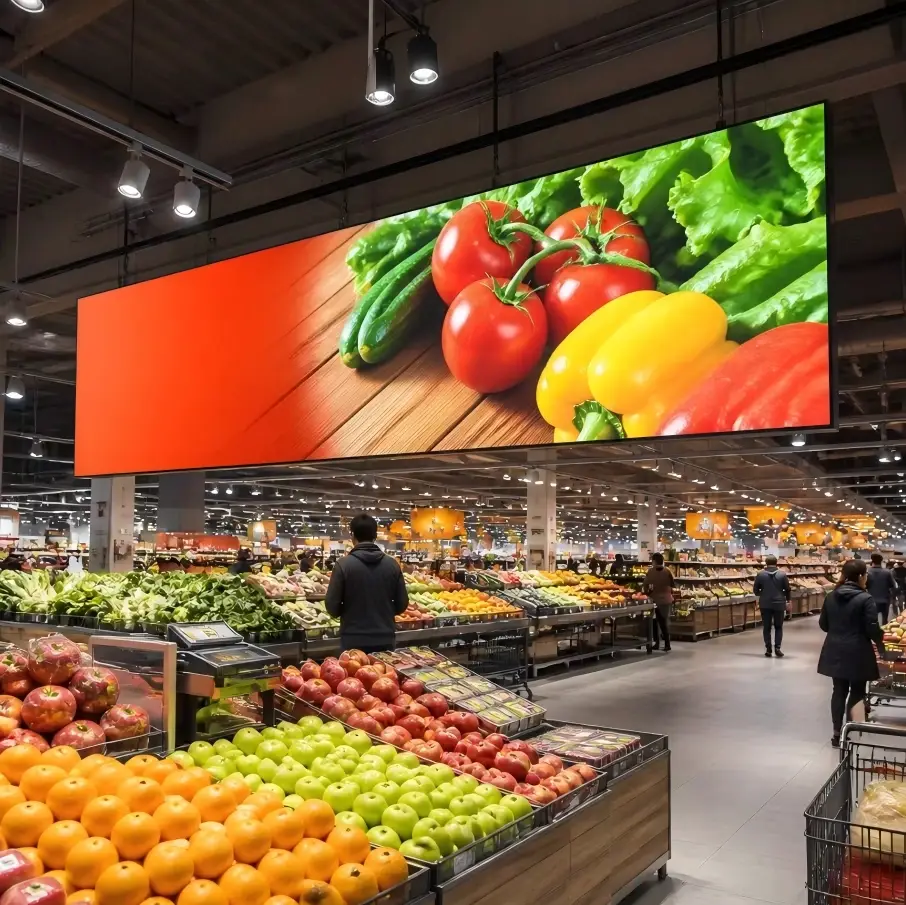
Retail chains usually install indoor LED displays for three commercial reasons, not for the sake of a brighter sign:
- Advertising inventory. One long screen can be split into three to five bookable slots — the display pays for itself.
- Dwell time. Motion keeps shoppers at the shelf a few seconds longer, and fresh produce is one of the highest-margin zones in the store.
- Zero-cost content changes. Promotions, seasonal campaigns and pricing update instantly, with no reprinted light boxes.
It is also a position that punishes shortcuts. Everyone in the store is holding a phone camera. If the refresh rate is too low, the screen films as rolling black scan lines. If the grey scale is too shallow, dark scenes break into blocks. For retail, the three things that decide whether the client stays happy are refresh rate, grey scale depth and calibration accuracy — and all three are fixed on the production floor, not in the showroom.
Why buyers everywhere search "Shenzhen LED display manufacture"
Ask purchasers in Riyadh, Warsaw or São Paulo where they source screens, and the same phrase comes up: Shenzhen LED display manufacture. The reason is not branding. It is density.
An LED display is a short bill of materials: lamps, driver ICs, PCBs, power supplies, receiving cards, cabinets, cables and sheet metal. Around Shenzhen and the wider Pearl River Delta, almost every one of those links sits within a one to two hour drive. For a buyer, that translates into three concrete advantages:
- Fast prototyping. Non-standard sizes, irregular shapes and specific colour temperatures can be sampled in days.
- Workable small batches. A single-store refurbishment of a few dozen square metres still gets scheduled.
- Spare parts that survive the warranty. When a module needs replacing in year five, matched lamps and driver ICs are still available. That is the difference between a repairable screen and a write-off.
The upstream and downstream structure of Shenzhen LED display manufacture. Cluster density is what buys you fast sampling, flexible customisation and a long spare-parts life.
There is a second, quieter advantage: export logistics. Yantian and Shekou handle dense direct services to the Middle East, Europe and the Red Sea, and the paperwork is routine. When you buy from a Shenzhen LED display manufacturer, you are buying into a chain that has been refined for decades.
Inside the factory: 7 steps from PO to container
Below is the standard sequence at a properly equipped Shenzhen LED display factory. Once you can read this flow, you know exactly what to ask during a factory audit — and where a suspiciously cheap quotation has quietly removed a step.
The seven production steps from purchase order to container. Point-by-point calibration and aging duration are the two stages that are easiest to shorten — and easiest for a buyer to verify.
The checkpoints that decide how it looks in year five
LED degradation is physics; no factory can prevent it. What separates suppliers is how much unacceptable product gets stopped before it leaves the building. These four checkpoints map directly onto the complaints you will — or will not — receive three years from now.
After point-by-point calibration, module-to-module colour deviation is held within a tight window. It is the only way a screen reads as one surface instead of a mosaic.
Everyone in a supermarket carries a camera. Low refresh produces scan lines on video; shallow grey scale breaks dark scenes into blocks. Both change how the advertiser judges your screen.
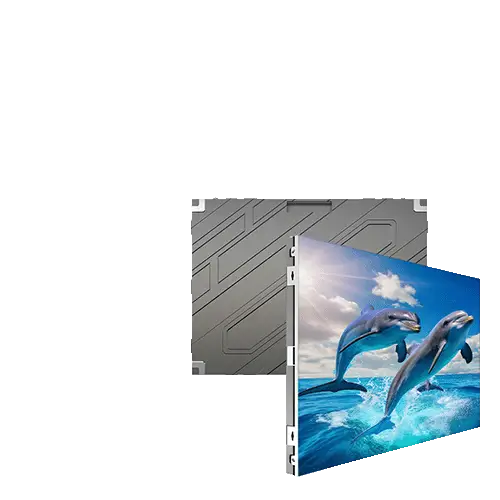
Seams and misalignment are glaring at three to six metres. Die-cast aluminium cabinet tolerance consistency is the spec that budget suppliers gloss over most often.
24 to 72 hours of burn-in exists to fail marginal lamps and solder joints inside the factory — not on your client's opening day.
Specs that actually matter for a supermarket LED display
You do not need to memorise a datasheet. You need to know which rows are retail-specific. The ranges below are typical industry values for selection reference; final numbers should come from the project specification and measured test data.
| Parameter | Typical retail value | Why it matters |
|---|---|---|
| Pixel pitch | P1.5 – P2.5 | The clarity-to-cost sweet spot at 3–6 m viewing distance |
| Brightness | 500 – 800 nits | Comfortable indoors yet still above store ambient light |
| Refresh rate | 1,920 Hz and up | No black scan lines when shoppers film the screen |
| Grey scale | 14 – 16 bit | Smooth gradients, no banding in dark scenes |
| Service access | Front-service magnetic modules | A store cannot close for repairs; single modules must swap fast |
| Cabinet material | Die-cast aluminium | Tighter tolerances, better heat dissipation, smaller seams |
| Ingress protection | IP40 indoor / IP54 semi-outdoor | Determines whether it can go at an entrance or behind glazing |
| Control system | Splitting and scheduled playback | The prerequisite for renting the screen as multiple ad slots |
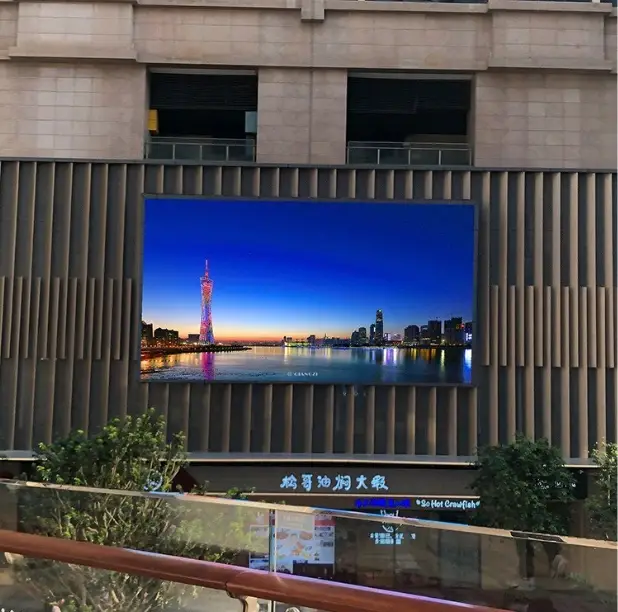
If one project covers both in-store screens and an entrance wall, consider pairing a supplier's COB LED display range with conventional SMD options. COB packaging is more resistant to impact and humidity and looks better up close, while positions exposed to strong light or weather suit a cabinet built to an IP65 rating. The practical point is to document both scenarios separately in a single specification, so nothing gets installed in the wrong place.
Factory, trading company, or agent?
In this industry, the label "Shenzhen LED display manufacturer" is used far too loosely. Many of the cheapest quotations come from suppliers who own no SMT line and no aging room — they are traders who place your order with a factory afterwards. That is not automatically wrong, but you should know what you are buying.
| Factor | Direct factory | Trading company / agent |
|---|---|---|
| Cost structure | No middle margin, though small orders may not be cheapest | One layer added, sometimes absorbed by downgraded components |
| Customisation | Non-standard sizes, shapes and colour temperature are negotiable | Limited by upstream scheduling |
| Traceability | Calibration reports and aging logs available | Usually only a summary datasheet for the finished goods |
| Spare parts | Matched lamps and ICs supplied for years | Dependent on upstream; often unsolvable in year five |
| Technical support | Installation guidance and remote commissioning | Mostly logistics and order tracking |
Four questions are enough to tell them apart: can we walk the SMT and aging floor on a live video call? Can you show the purchase record for this lamp batch? What equipment do you calibrate with? And if I add thirty square metres, what is the production slot? A trader's answers to those four tend to stay vague.
A 6-point checklist before you place the order
Attach these six items to the contract instead of re-reading datasheets. They are actionable rather than aspirational — each one can be ticked off at delivery.
Make the checklist a contract annex and tick each line at delivery. It outperforms any verbal promise.
5,840 hours a year: the cost most buyers forget
Price comparisons usually stop at unit cost and brightness. The number that actually drives total cost is duty cycle. A retail screen typically runs 14 to 16 hours a day — close to 5,840 hours a year — and a 24/7 outdoor installation exceeds 8,000. The longer the duty cycle, the higher the required grade of lamp, power supply and thermal design.
Annual runtime by application. Duty cycle is the first yardstick for deciding which grade of lamp and power supply a project actually needs.
Put that figure into a lifecycle view and the conclusion becomes obvious. Purchase price is only the first payment; spare parts, repairs, downtime and re-calibration follow. A screen that costs 10% less and needs a full module replacement in year three ends up more expensive than the supplier who quoted slightly higher at the start.
Key takeaways & FAQ
If you keep only one page from this article, keep this table.
| Term | In one line | What it means for you |
|---|---|---|
| Shenzhen LED display manufacture | The LED display manufacturing cluster around Shenzhen | Fast sampling, small batches, long spare-parts life |
| Point-by-point calibration | Measuring and correcting each LED's brightness and colour | The screen reads as one surface, not a mosaic |
| Burn-in / aging test | 24–72 hours at full load before shipping | Early failures surface in the factory, not on site |
| Pixel pitch | Centre-to-centre distance between pixels, in mm | Sets viewing distance and cost; retail usually P1.5–P2.5 |
| Refresh rate | How many times per second the image is redrawn | Too low and phone cameras capture black scan lines |
| COB packaging | LEDs encapsulated directly on the board, no exposed frame | More impact and moisture resistant, better up close |
| IP65 | Dust-tight and protected against water jets | The entry bar for semi-outdoor and outdoor positions |
| Lifecycle cost | Unit price + spares + repairs + downtime | A low quote is not a low cost |
Frequently asked questions
A factory owns the SMT line, the aging room and the calibration equipment, and can supply the matching calibration report, aging log and spare modules years later. A trading company takes the order and buys from the factory, so specifications, quality and after-sales support depend on an upstream party you never meet.
Around 500–800 nits is enough for indoor retail. Brighter is not better: excessive brightness washes out the image and accelerates degradation. Uniformity and calibration accuracy affect perceived quality far more than peak brightness.
No. LEDs degrade at different rates depending on colour, temperature and duty cycle. Factory calibration fixes initial consistency; after long service the screen may benefit from re-calibration on site. That is why you should confirm the control system can reload calibration coefficients.
Indoor displays are typically produced on a schedule measured in weeks rather than days, depending on specification and quantity. Add sea freight and customs clearance, and total lead time usually lands somewhere between a few weeks and roughly two months. Put production milestones, aging hours and the sailing date in the contract instead of a single delivery date.
Yes. Single-store refurbishments and chain roll-outs of a few dozen square metres are routine in the Shenzhen supply chain. Most factories set a minimum order in module quantities, and non-standard sizes need extra confirmation on tooling and scheduling. Sending site photos with dimensions is the fastest route to an accurate proposal.
Send us your site dimensions and viewing distance
We will come back with a pixel pitch recommendation, a screen layout and a price range — plus our standard point-by-point calibration and aging test procedure.
Get an LED display proposal Or ask about indoor / outdoor screen selection →This article is original technical editorial. Ranges quoted are typical industry values for selection reference; final decisions should follow the project specification, third-party test reports and on-site measurements.
Photos show reference installations and remain the property of this website. The production steps described are common manufacturing practice; sequence and naming may differ slightly between factories.