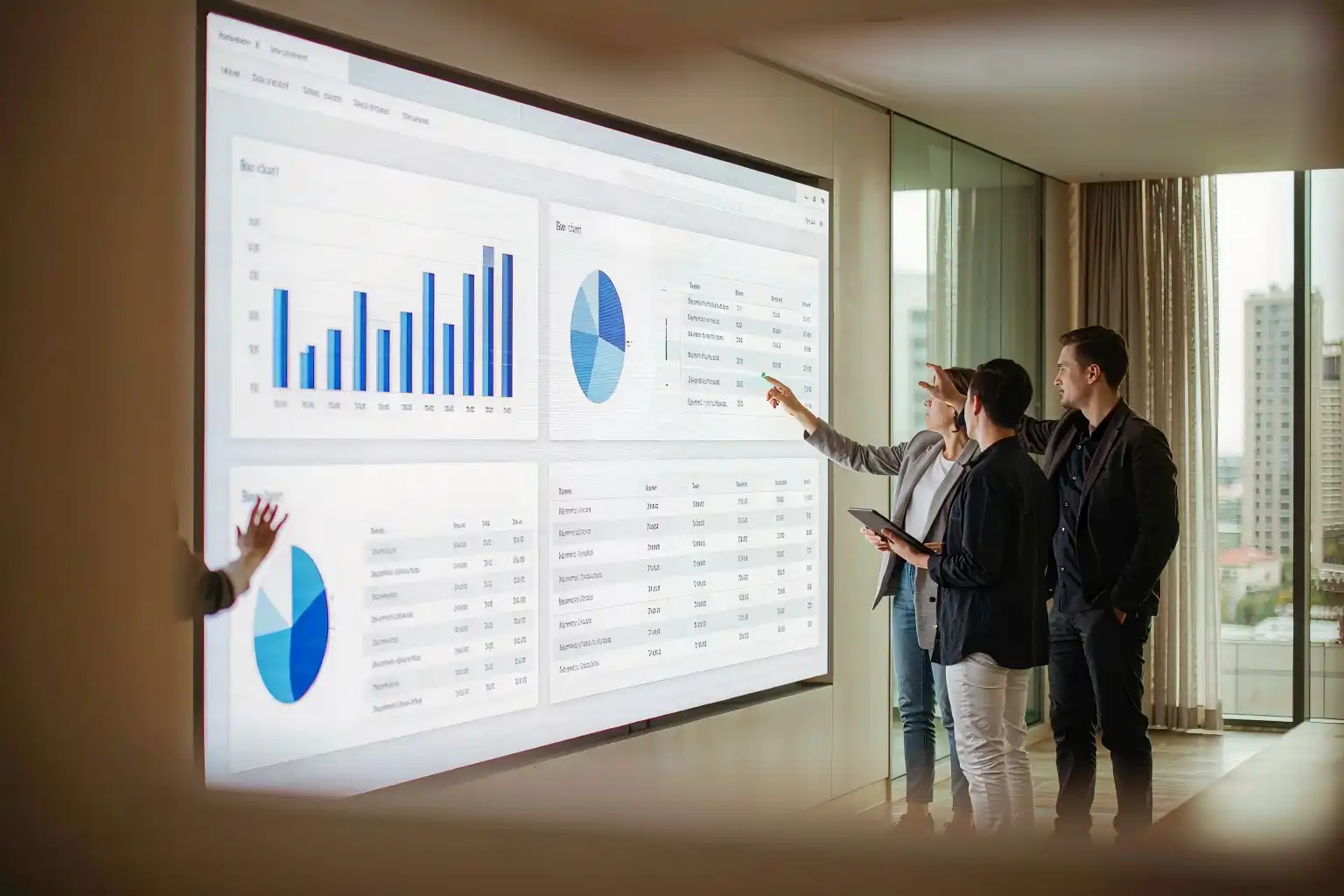
Asynchronous Playback on COB LED Displays: The Complete PC and Mobile Workflow
Publish once, walk away, and the screen keeps playing. That is the entire promise of asynchronous control. Adapted from Chapter 7 of the NovaStar NCE certification textbook LED Display Application — Fundamentals, this guide walks engineers through the system architecture, the PC software workflow, mobile app remote management, USB updates, and scheduled tasks — with a COB LED display selection lens on every step.
- The site visit you never needed
- Synchronous vs asynchronous: two control philosophies
- PC software workflow: from new program to on-screen publish
- USB export: updating content with zero network
- The mobile app: a control room in your pocket
- Scheduled tasks: let the screen manage itself
- Why COB LED displays and asynchronous control fit together
- Key takeaways, FAQ, and selection advice
1. The Site Visit You Never Needed
Every display engineer knows this one. A COB LED display is running a perfect loop in a retail window or a corporate lobby — until the client calls: "Can we swap in the new promo video?" Suddenly you are hauling a laptop on site, hunting for a network port, configuring IPs, connecting, publishing, verifying. Thirty minutes of fieldwork to replace a 30-second clip.
The problem is never the panel. It is the control architecture. Many projects default to a synchronous system, where a computer feeds live frames to the screen — which means a dedicated PC babysits the display 24/7. For fixed-content looping scenarios, that is overkill. An asynchronous (standalone/offline) playback system is the right tool: content is produced once, published to the control card's onboard storage, and the screen loops it on its own. The computer and the phone can both leave the building.
This guide covers the whole picture: how async differs from sync, how the PC software works, what the mobile app can do, how USB updates fit in, and how to configure scheduled tasks — with COB LED display engineering context throughout.
2. Synchronous vs Asynchronous: Two Control Philosophies
Clear up the classic confusion first. A synchronous system is a live mirror: the sender card reads whatever the computer displays and pushes it to the LED screen in real time. Computer off, screen dark. An asynchronous system is content hosting: a finished program package is published into the async control card's storage, and the card parses and loops it standalone — completely independent of whether the authoring machine is online.
A typical asynchronous system has three hardware building blocks: the async control card or media player box (parses the program and drives the panel), the storage (onboard memory or TF card holding the program package), and the communication interfaces (Ethernet, WiFi, optional 4G — these decide how your content reaches the card). Once this clicks, every software operation that follows becomes obvious: everything you do is ultimately "place a program package into that storage, and tell the card how to play it."
3. PC Software Workflow: From New Program to On-Screen Publish
Using the NovaStar ecosystem's PC tools (ViPlex Express and its siblings) as the reference, the workflow is remarkably consistent across vendors — learn it once, apply it everywhere. Six steps:
Step-by-step, with field notes
Find the device
Set screen parameters
Create the program
Layout media zones
Preview & verify
Publish to the screen
4. USB Export: Updating Content with Zero Network
USB updating is the most "primitive" and most dependable publishing channel in the async world — job sites, basements, and shops without WiFi all depend on it. The logic is simple: in the PC software, export the finished program as a USB package, copy it to a flash drive, and plug the drive into the control card's USB port. The card detects the drive, imports the program automatically, and starts playing — no network, no computer, no drama.
Three field tips: format the drive as FAT32 for maximum compatibility; export screen parameters together with the program so a card swap or reset recovers quickly; and watch the indicator LEDs — never yank the drive mid-import.
5. The Mobile App: A Control Room in Your Pocket
If the PC software owns "content production," the mobile app (ViPlex Handy and equivalents) owns daily operations. Standing in front of the screen, your phone handles most of the workload — the single biggest efficiency gain asynchronous control delivers.
Two connection modes
High-frequency app operations
6. Scheduled Tasks: Let the Screen Manage Itself
The scheduling capability of async systems is chronically underrated. From the PC software or the mobile app you can configure three core task types: scheduled power on/off (bright during business hours, dark after close), scheduled playback (different programs in different slots — morning greetings, midday promos, evening brand films), and scheduled brightness (high luminance to fight daylight, dimmed at night — saving power while extending panel life).
For 24/7 commercial deployments, the brightness schedule deserves a line in every implementation plan. COB LED display products are already marketed on low-brightness/high-grayscale performance and long-duration stability — layering time-based brightness management on top makes total power draw and luminance decay far more predictable. Until scheduling is configured, the screen is not truly unattended.
7. Why COB LED Displays and Asynchronous Control Fit Together
Shift the view from the operating desk to the selection desk: why are COB and asynchronous playback a natural pair? From the display side, COB packaging bonds the LED chips directly onto the substrate — better protection, better thermal behavior, and higher reliability than fine-pitch SMD — making COB inherently suited to long-duration continuous operation, which is exactly how async systems run: publish once, loop indefinitely. From the architecture side, here is a typical unattended chain:
In practice: retail storefronts and shop windows (scheduled power plus phone-based promo swaps), corporate lobbies and meeting rooms (USB/LAN publishing of brand content), exhibitions and transit signage (cloud-managed multi-screen fleets). If your project also needs live synchronous feeds or large-scale wall processing, an asynchronous layer coexists with a video wall controller — async owns content hosting, the controller owns signal routing and real-time display. They are not competitors.
8. Key Takeaways, FAQ, and Selection Advice
| Topic | Core point | Memory hook |
|---|---|---|
| Sync vs async | Sync mirrors the PC live; async stores a program on the control card and loops it offline | Live wants sync, looping wants async |
| Async building blocks | Control card (parse & drive) + storage (program package) + comms (LAN/WiFi/4G) | Every operation is "store the program, tell the card how to play" |
| PC workflow | Find device → set params → create program → layout zones → preview → publish | Wrong params always bite; check network before software |
| Publish channels | Direct LAN / cloud push / USB import | USB is the no-network fallback; FAT32 is safest |
| Mobile value | Hotspot for on-site work, cloud for remote fleets, alerts before complaints | A control room in your pocket |
| Scheduled tasks | Timed power, timed programs, timed brightness | Unattended starts with scheduling |
| COB fit | COB reliability for continuous play + async offline looping = low-ops 24/7 chain | A naturally matched pair |
Can asynchronous systems play video, or only images and text?
Video is fully supported. Modern async control cards and media player boxes handle common formats like MP4 offline, mixed with image, text, ticker, clock, and temperature zones. The real constraint is onboard storage capacity versus video bitrate — compress before you publish.
Does my phone have to be on the same network as the screen?
No. On-site work can use the control card's WiFi hotspot directly. Once the card is connected to the WAN and bound to a cloud platform, your phone manages it remotely from anywhere — the standard setup for distributed retail fleets.
Anything special about running COB LED displays on async control?
COB is a high-density fine-pitch technology, so loading logic is finer. Confirm the control card supports your COB cabinet's scan mode, refresh rate, and brightness grading, and configure parameters from the actual module data sheet — reusing a legacy SMD template is a fast route to display artifacts.
The publish "succeeds" but the screen does not update. What do I check?
Four things, in order: did you publish to the right card (multi-card searches are a classic mix-up); does program resolution match the screen parameters; is the storage full; does the card need a restart to load the new program. Nine times out of ten it is one of the first two.
If I already run async, do I still need a video wall controller?
Different jobs. Async handles content hosting and looping; a video wall controller handles multi-input synchronous signal routing, wall processing, and real-time display. Pure looping screens need async only. Add a controller when live PC feeds, source switching, or large-scale processing enter the project — the two coexist in the same installation.
Planning a COB LED display project with asynchronous playback?
We supply COB LED displays and the PEL series video wall controllers to overseas buyers and AV integrators — from module specs and control architecture to complete screen delivery. Bring your panel parameters and let's talk.
Get COB LED Display Pricing & Specs