Delivering a 200 sqm P4 Outdoor COB LED Display for a Riyadh Shopping Mall
This is not a product brochure. It is a post-mortem of a real overseas project — from the first enquiry to a 200 sqm facade screen running reliably through 47°C heat and desert dust. Eight stages, fourteen technical decisions. The point of writing it down: almost every failure happens in the questions nobody asked upfront.
What's in this article
- 63 days to opening, and all we had was a steel frame
- Stage 1: Scoping — the first thing I asked was not the price
- Stage 2: Why P4 + COB, and not SMD
- Stage 3: Four design responses to Riyadh's climate
- Stage 4: Sampling, quotation, and the boundaries you must write into the contract
- Stage 5: Production, point-by-point calibration and a 72-hour burn-in
- Stage 6: Packing, certification and shipping into Saudi Arabia
- Stage 7: Site installation and first light
- Stage 8: Handover and after-sales — where reputation is actually made
- Total cost of ownership: the number your CFO should be looking at
- Key takeaways (save this checklist)
- Frequently asked questions
63 Days to Opening, and All We Had Was a Steel Frame
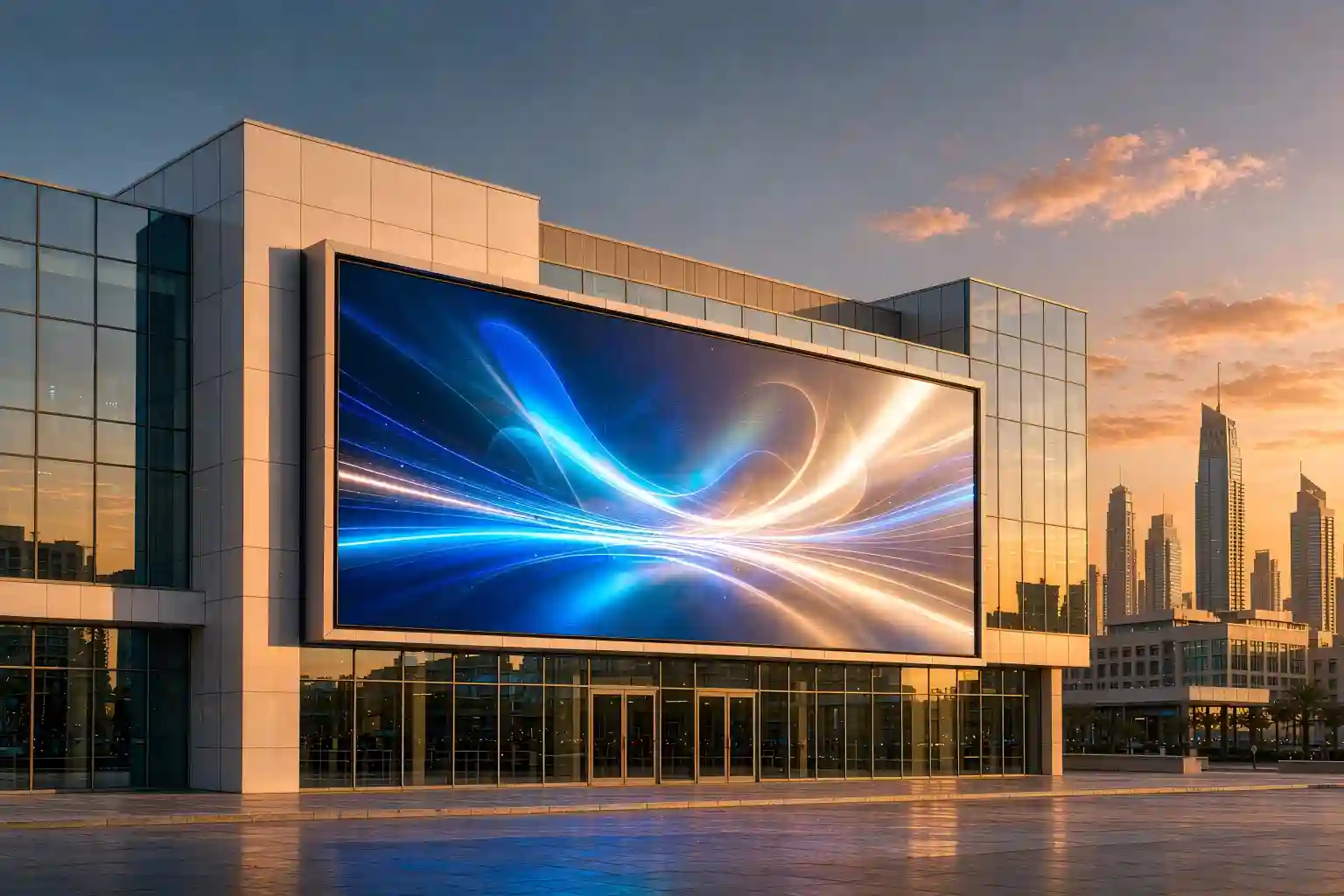
Riyadh. Two in the afternoon, 44°C outside. The steel structure on the mall facade was hot enough that you could not rest a hand on it.
The client was the operator of a regional shopping centre. The opening date had been locked months earlier — it was tied to tenant contracts and government approvals, and it could not move. Their original winning supplier had lost control of module lead times and pushed the project to the edge of the red line. By the time they reached us, the entire screen had nine weeks left.
The site conditions made it worse. Three problems sat on the table:
47°C
Peak summer ambient temperature. The steel behind the screen runs even hotter. Get the thermal design wrong and brightness starts to sag within six months.
Dust year-round
Fine sand and airborne dust get into every gap. On a conventional outdoor screen, exposed LED lamps and the mask holes around them are the first things to fail.
Direct sun
The facade faces the main road and takes direct sunlight for most of the afternoon. Without enough brightness, the screen is just a reflective black board by day.
Most people assume an outdoor LED display simply needs to be "brighter and a bit more waterproof". In Riyadh, that assumption is wrong — and it is the kind of wrong that only surfaces eight months after handover.
Start with this: in Middle East outdoor projects, roughly 80% of the outcome is decided by three numbers in the design phase — pixel pitch, brightness, and thermal headroom. They determine whether the screen is an asset in year one or a liability in year three.
Stage 1: Scoping — the First Thing I Asked Was Not the Price
The client's first email read: "200 square metres, outdoor screen, please quote." That is the most dangerous kind of enquiry, because there is not enough information in it to produce a single correct number.
Our reply contained no pricing, only a checklist. Because area and dimensions are not the same thing. 200 sqm could be 20 m × 10 m, 25 m × 8 m, or even 40 m × 5 m. And whether the screen can physically sit on that facade depends on column spacing, fire access and structural load limits — not on the aspect ratio the client prefers.
Six things you must lock down first
| Question | Why it drives cost | Actual answer on this project |
|---|---|---|
| Primary viewing distance | Determines pixel pitch. The closer the audience, the finer the pitch must be, and cost scales non-linearly | 10–35 m for traffic; nearest pedestrians around 8 m |
| Dimensions & aspect ratio | Drives cabinet layout, steel design, and whether the screen divides into whole cabinets without custom tooling | 20 m (W) × 10 m (H) = 200 sqm |
| Mounting method | Wall-mounted, pole, suspended or facade-framed — the steel can add up to 20% on top of the screen itself | Outdoor facade mount; front service not possible, rear access corridor required |
| Power supply conditions | Determines cable sizing, distribution board capacity, and whether a dedicated plant room is needed | Mixed 380 V / 220 V on site — needed on-site verification |
| Content and operating hours | Drives peak power draw, thermal strategy, and whether ambient-light dimming is mandatory | Advertising plus mall wayfinding, 10:00–24:00 daily |
| Parallel third parties | Steelwork, rigging, power, content — whoever owns each one is your number-one source of late-stage disputes | Client provided rigging and power; we supplied screen and commissioning |
Worth saving. On any outdoor LED display enquiry, having these six answers raises the accuracy of your quotation by an order of magnitude.
Fig 1 | Six stages from enquiry to after-sales. The more thorough stage one is, the less rework you inherit in the other five.
Stage 2: Why P4 + COB, and Not SMD
Start with P4: pitch is calculated from viewing distance, not from budget
There is a useful rule of thumb in the industry: minimum comfortable viewing distance ≈ pixel pitch (mm) × 1.5–2, expressed in metres.
Run P4 through it: 4 × 1.5 ≈ 6 m, and 4 × 2 ≈ 8 m. On this project the nearest pedestrians stand roughly 8 m away, with vehicles and street traffic at 15–35 m. P4 lands exactly in the sweet spot. Step up to P5 and pedestrians close in will see visible pixel structure. Step down to P2.5 and you more than double pixel density and cost, for a difference nobody can perceive beyond 8 m.
The selection logic in one line: pixel pitch serves exactly one goal — the closest viewer should not be able to see individual pixels. Paying for viewers further away is pure waste.
Then choose the encapsulation: what COB actually changes
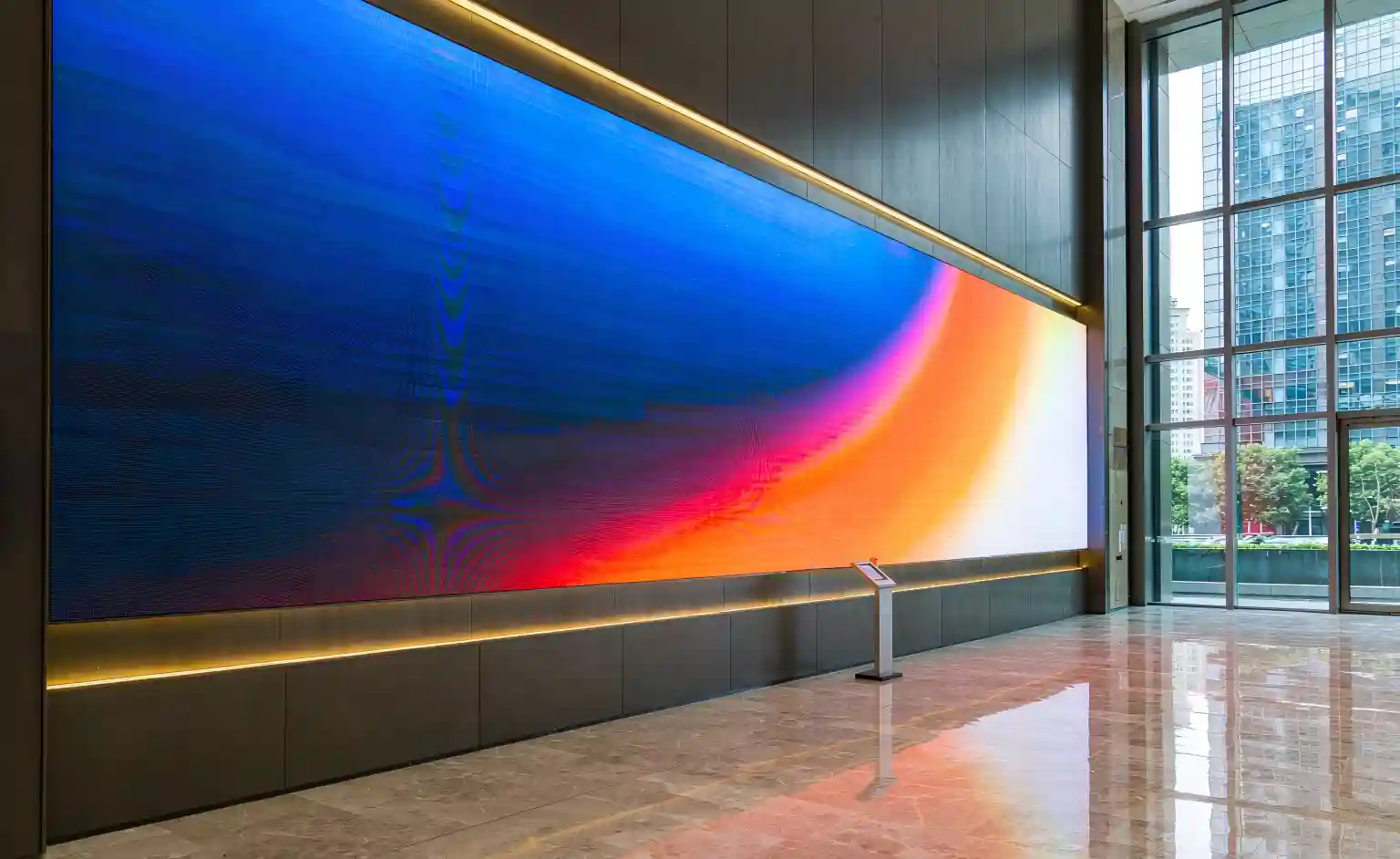
SMD packaging turns each RGB LED into a discrete lamp, places them individually on the PCB, and covers the surface with a plastic mask. COB — Chip on Board — bonds the LED dies directly onto the PCB surface and encapsulates the whole board in a matte resin layer. The screen face becomes one continuous surface: no exposed lamps, no mask holes.
In an environment of high heat, airborne dust and intense UV, that structural difference compounds into a completely different maintenance curve.
| Dimension | Conventional SMD outdoor | COB outdoor |
|---|---|---|
| Surface structure | Exposed lamps plus mask, with gaps between them | Continuous resin encapsulation, no surface perforations |
| Dust behaviour | Dust lodges in mask holes; localised dimming and colour shift | Dust stays on the surface and wipes off |
| Water & ingress | Relies on mask plus potting; many seams and interfaces | Inherently sealed — IP65 is far easier to hold at screen level |
| Impact resistance | A single struck lamp fails and becomes a dead pixel | Protected surface; markedly better against knocks and contact |
| Black-level consistency | Batch variation across lamps and masks creates visible tiling | Single-process board; face colour is highly uniform |
| Contrast & low grey | Mask reflects light; blacks lift and low grey looks washed out | Matte surface absorbs light; deeper blacks, smoother grey ramp |
| Horizontal viewing angle | Roughly 140°–160°, with visible falloff at the edges | Approaching 170°, so picture holds around facade corners |
| Service model | Lamp or module replacement; frequent work at height | Module-level replacement; lower failure rate, less work at height |
| Power at equal brightness | Higher, with heat concentrated at lamp solder joints | Lower, with heat spread more evenly and a shorter thermal path |
| Upfront purchase cost | Lower | Higher — typically 20%–30% above SMD |
Note the pattern: COB has exactly one downside — it costs more upfront. Every other line is about long-term stability. For a mall facade whose job is to sell advertising, the arithmetic is not difficult.
Fig 2 | How "lamp + mask" and "single-surface encapsulation" diverge in a dust-laden environment (cross-section schematic).
Stage 3: Four Design Responses to Riyadh's Climate
Choosing the encapsulation is only half the job. Four things are what actually keep this screen alive in Riyadh.
1. Brightness: 6,500 nits is the floor, not a selling point
An outdoor screen has to overpower direct sunlight. The industry benchmark is 5,000–7,000 nits for direct-sun exposure. This project was designed at 6,500 nits peak with ambient-light sensor auto-dimming — full power by day, stepped down to 800–1,200 nits after dark. That is not about saving electricity. It is about avoiding complaints: there are residential buildings across the road, and an over-bright facade invites formal complaints, forced dimming, or restricted operating hours.
2. Thermal: build in 30% more headroom than you think you need
This is the most consistently underestimated factor in Middle East projects. An ambient 44°C means the internal operating temperature of the screen is well above 44°C, and both brightness depreciation and wavelength drift rise exponentially with junction temperature. We addressed it three ways: a low-power common-anode driver scheme to reduce self-heating; separate positioning of power supplies and driver boards so heat sources do not stack; and cooling cabinets sized with 30%+ headroom over peak draw.
Power draw is normally estimated like this: a high-brightness outdoor screen peaks around 250–350 W per sqm. At 200 sqm that means 50–70 kW of peak demand, with average consumption running 35%–45% of peak. Those numbers have to be calculated before contract signature and handed to the client's electrical engineer.
Fig 3 | Auto-dimming tracks ambient light instead of burning 6,500 nits for 24 hours straight.
3. Dust and wind load: structural safety is a zero-tolerance item
Making the housing IP65-rated for front service is only step one. At height in Riyadh, a 200 sqm screen is effectively a very large sail. Wind load calculations must use the local basic wind pressure, with height and shape coefficients applied — not experience from domestic projects where the climate and code are different. Put this in the technical agreement. Hand it to a steel contractor with no Middle East experience and the risk lands directly on your screen.
4. Glare and viewing geometry: don't fire light into the windows opposite
Mall facades are usually long horizontal bands, viewed from below at close range. We specified an upward tilt of 5°–8° so the optical axis points into the street's viewing band while steering clear of residential windows opposite. COB's near-170° horizontal angle also keeps the picture intact for foot traffic approaching around the corner.
Fig 4 | Around 12.5 million pixels across 400 cabinets — this figure drives your spare-parts ratio and shipping crate count.
Stage 4: Sampling, Quotation, and the Boundaries You Must Write Into the Contract
A nine-week schedule leaves no room to "sign first and work out the details later". We compressed the proposal into a decision-ready package built on three things.
Sample first: build four cabinets before you build four hundred
Before mass production we assembled four cabinets into a 2 sqm mock-up and took it outdoors at local noon for a real-world visibility test, while also verifying seam tolerance and surface flatness. That cost five days and removed a risk that could have forced an entire production batch to be redone.
Six line items that must appear in the quotation
| Quotation block | Where things get omitted |
|---|---|
| Screen & cabinets | Are spare modules included? Typically 3%–5% of total |
| Control system | Sending cards, receiving cards, video processor and signal redundancy |
| Power & cabling | Power supplies, internal harness, main cables — and who supplies the distribution board |
| Steelwork & installation | Who designs it, who builds it, who handles rigging and work-at-height certification |
| Shipping & certification | Crates, moisture control, insurance, destination charges, who pays for certification |
| Service & training | On-site commissioning days, number of trainees, warranty term and response SLA |
The single most common source of disputes: steelwork. Plenty of overseas projects discover that the frame is 20 mm out of tolerance after the screen arrives — and it will not fit. Write this into the contract: steel anchor hole tolerance of ±2 mm, with frame acceptance completed and photographic evidence supplied before the screen ships.
Stage 5: Production, Point-by-Point Calibration and a 72-Hour Burn-In
Production is the part the client cannot see, which makes it exactly the part that needs evidence. We issue four standard records every time:
- Point-by-point calibration report — brightness and chromaticity adjusted per pixel, driving module-to-module colour deviation below the threshold of human perception.
- 72-hour continuous burn-in log — three days at full load to screen out early-life failures (the left side of the classic bathtub curve).
- White balance and low-grey test patterns — mall advertising is mostly dark backgrounds with small text, and poor low-grey performance makes lettering look blurry.
- 1:1 pre-assembly photographs — the full screen assembled once at the factory to verify seams, flatness and cabinet numbering, with that numbering passed to the site installation crew.
Why calibration matters more on a mall screen
Mall facade content depends on cleanliness: solid backgrounds, brand colours, moving slogans. Any brightness or chromaticity variation between modules shows up as visible tiling. Viewers cannot explain what is wrong — they simply conclude the screen looks cheap.
Fig 5 | Calibration is the line between "it works" and "it looks right" — and between a commercial-grade job and a mall-grade one.
Stage 6: Packing, Certification and Shipping Into Saudi Arabia
Certification: where first-time Saudi projects most often get stuck
Importing into Saudi Arabia means going through the SABER platform, which normally involves two certificates: PCoC (Product Certificate of Conformity, valid annually) and SCoC (Shipment Certificate of Conformity, issued per consignment). If the documentation is incomplete the shipment sits at the port, and demurrage can easily outrun what you saved by cutting corners.
Start the certification process when the contract is signed, not when the goods are ready. On a nine-week schedule this is the most frequently overlooked critical path item.
Packing: getting 400 cabinets to Riyadh alive
- Individual cushioning per module group, with buffer layers between crates, so ocean vibration does not chip edges.
- Full moisture protection — desiccant plus barrier film. High humidity inside a sea container is a leading cause of PCB corrosion.
- Fumigated timber crates compliant with destination requirements, and a cabinet numbering diagram in every crate so the site crew can rig in sequence.
- Spares packed and labelled separately. Do not bury them inside the main batch — nobody can find a spare module during a night-time fault call.
| Milestone | What is required / who owns it |
|---|---|
| Production complete | Factory inspection report, packing list, cabinet numbering diagram |
| Before shipment | PCoC in force → apply for SCoC; invoice, packing list and B/L details must match |
| Customs clearance | Importer needs an active SABER account; confirm the clearing agent in advance |
| Site acceptance | Inspect for impact damage and moisture on opening; photograph and notify the carrier immediately |
Stage 7: Site Installation and First Light
The workable installation window in a Riyadh summer is narrow. All work at height was scheduled for 05:00–10:00 and after 19:00, with midday reserved for transporting cabinets and ground-level preparation. This is not about comfort — excessive steel surface temperature directly affects both safety and productivity.
Eight steps, and the order matters
1. Frame verification
Level, plumb, anchor positions, load capacity and wind connections. Ticked off before a single cabinet goes up.
2. Hoisting
Assemble outward from the centre using the factory numbering plan, so accumulated tolerance does not all land on the final cabinet.
3. Cabinet joining
Control seam tolerance and overall flatness — this is the most visible indicator of build quality to the naked eye.
4. Power and signal routing
Separate conduits for power and data; receiving cards on a redundant ring so a single break does not kill the screen.
5. Full-screen pixel scan
Solid red, green, blue and white sweeps to find dead pixels, mis-mapped cabinets and reversed modules.
6. On-site calibration
Ambient temperature and humidity affect output, so on-site calibration beats factory data every time.
7. Content and brightness tuning
Tune colour temperature, gamma and the dimming curve against real content — not just "maximum brightness".
8. Overnight soak test
At least 48 hours running the real playlist, monitoring temperature rise, PSU load and picture stability.
Fig 6 | Certification and ocean transit are the only two segments on this timeline you cannot compress. Both must start first.
Stage 8: Handover and After-Sales — Where Reputation Is Actually Made
Powering the screen on is not the end of the project. A handover checklist protects both sides, and it is how you tell a supplier who can build a screen from one who stays with it.
| Acceptance item | What to check (worth writing into the contract) |
|---|---|
| Dead pixel rate | Industry norm is ≤ 3 in 10,000, with the maximum allowed per module stated explicitly |
| Brightness & uniformity | Measured peak brightness on spec; uniformity typically specified at ≥ 97% |
| Colour temperature | No patchiness on a full-white field; deviation within the agreed tolerance |
| Low-grey performance | Play dark background with fine text; confirm no blurring and no grey stepping |
| Power draw & temperature rise | Measure at full load; log key point temperatures after two hours of continuous running |
| Water and sealing | Water spray test per the agreed method; inspect cabinet interiors for ingress |
| Signal redundancy | Pull any single signal cable; the picture should not drop out or go black |
| Power-loss recovery | After a power cut, playback and brightness settings restore automatically without intervention |
After-sales package: let the mall carry itself through year one
- Spares kit — 3%–5% spare modules, PSUs and control cards, shipped with the screen, not after it.
- Operator training — at least two mall staff trained on daily power-up, content updates and common alarm handling.
- Remote support — network the control system so most faults can be diagnosed remotely, avoiding a work-at-height visit for every issue.
- Warranty and SLA — define the warranty term, response time and spare-parts dispatch time. Those three specifics matter far more than the phrase "two-year warranty".
Total Cost of Ownership: the Number Your CFO Should Be Looking At
Procurement decisions often stall on "how much more does COB cost than SMD". The question that actually matters is what you will have spent over five years, and how many hours the screen was dark. For a mall, a dark screen is not a technical problem — it is lost advertising revenue.
| Five-year view (index) | Conventional SMD outdoor | COB outdoor |
|---|---|---|
| Upfront purchase cost | 100 | 118 – 130 |
| Failures causing downtime over 5 years (dusty climate) | 8 – 12 | 2 – 3 |
| Cost per work-at-height repair | 100 | 60 – 70 |
| Total 5-year maintenance cost | 100 | 35 – 50 |
| Total 5-year cost of ownership | 100 | 82 – 95 |
| Face colour consistency over time | Noticeable; visible patches by year 2–3 | Minimal; stays uniform long-term |
Relative indices based on typical industry ranges, shown to illustrate order of magnitude. They are not a quotation. Actual figures depend on site conditions, climate and maintenance practice.
Fig 7 | Relative indices for illustration. COB's advantage is not on the purchase order — it is in the invoices from year two onwards.
Key Takeaways
Here is the whole project compressed into one table. Use it as a checklist the next time you scope an outdoor screen for the Middle East or any hot, dusty climate.
| Stage | Key action | Common pitfall |
|---|---|---|
| Scoping | Lock six items: viewing distance, aspect ratio, mounting, power, content hours, third-party boundaries | Area is not dimensions — the wrong ratio means cabinets will not divide cleanly |
| Pixel pitch | Min. comfortable distance ≈ pitch (mm) × 1.5–2, in metres | Specifying a finer pitch than the audience can perceive is pure waste |
| Encapsulation | Choose COB for heat + dust + UV; SMD remains valid for mild climates and short horizons | Judging on purchase price alone hides the five-year maintenance bill |
| Brightness | 5,000–7,000 nits for direct sun, plus ambient-light auto-dimming | Not dimming at night invites resident complaints and forced restrictions |
| Thermal design | Budget 250–350 W per sqm peak with 30%+ cooling headroom | Sizing cooling for a temperate climate is the biggest hidden risk in the Gulf |
| Structural safety | Wind load per local code, with height and shape coefficients applied | Agree ±2 mm anchor tolerance and inspect the frame before shipping |
| Glare control | A 5°–8° upward tilt keeps the optical axis off residential windows | Get the viewing geometry wrong and there is no fix after installation |
| Production proof | Point-by-point calibration, 72h burn-in, low-grey patterns, 1:1 pre-assembly | "Good quality" without photographs and reports is not verifiable quality |
| Certification | Saudi Arabia needs SABER: PCoC (annual) plus SCoC (per shipment) — start at contract signing | Certification is the one critical path you cannot compress; late start means late delivery |
| Packing | Cushioned module packing, moisture control, fumigated crates, numbering diagram | Spares must be packed and labelled separately — never inside the main batch |
| Installation | Verify frame → assemble from centre outward → separate conduits → signal ring redundancy | In hot climates, schedule work at height for early morning and night |
| Acceptance | Dead pixels, uniformity, colour temp, low grey, power and thermal rise, water test, redundancy, recovery | Put acceptance criteria in the contract — verbal agreements do not survive handover |
| After-sales | 3%–5% spares, two trained operators, networked remote support, defined response SLA | Response time affects the real experience far more than the warranty length |
| Cost lens | Compare on five-year total cost of ownership, not on the purchase order | For a mall, lost airtime usually costs more than the repair itself |
Frequently Asked Questions
How long does a 200 sqm outdoor P4 LED display take to deliver?
Production typically runs 4–6 weeks, plus 2–3 weeks of ocean freight to a Middle East port. What really determines the total schedule is certification and structural readiness: SABER certification for Saudi Arabia must be started early, and the steel frame has to be finished and accepted before the screen arrives. On this project the whole thing took nine weeks because both tracks ran in parallel.
COB outdoor LED displays cost more than SMD. Is it worth it?
It depends on the climate and the service life. In hot, dusty, high-UV locations, COB typically runs 20%–30% higher upfront, but five-year maintenance cost often comes in at less than half of SMD, with significantly fewer outages. If the site is in a mild climate and the expected horizon is only 2–3 years, SMD remains a perfectly reasonable choice.
Is higher brightness always better for an outdoor screen?
No. Excessive brightness creates three problems: higher power draw and heat, light pollution and complaints at night, and accelerated brightness depreciation from running at high load continuously. The right approach is ambient-light auto-dimming — enough output to stay readable in sunlight, stepping down to 800–1,200 nits after dark.
How much does Riyadh's heat actually affect screen lifespan?
A great deal, and it is gradual rather than sudden. As junction temperature rises, brightness depreciation accelerates noticeably and wavelength drift introduces colour shift. Thermal headroom, a low-power common-anode driver scheme, and physically separating power supplies from driver boards are the three design decisions that extend life — and all three must be settled at design stage. None can be retrofitted later.
What certification is required to export LED displays to Saudi Arabia?
You generally need to go through the Saudi SABER system and obtain PCoC (Product Certificate of Conformity, valid annually) and SCoC (Shipment Certificate of Conformity, issued per consignment). Also confirm electrical compatibility with local voltage and frequency, and make sure the importer holds an active SABER account. Agree who bears certification cost and responsibility at contract stage.
Planning an outdoor LED display project in the Middle East or another hot climate?
Send us site photos, facade dimensions and your target viewing distance. Within 24 hours you will receive an initial proposal covering pitch recommendation, brightness and thermal configuration, and a five-year cost-of-ownership estimate. For projects above 200 sqm we can produce a 1:1 mock-up for on-site testing.
Request a Project Proposal →
Based on experience from real overseas projects. Technical parameters, cost indices and schedules shown here are typical industry ranges, used to illustrate design logic and order of magnitude; any specific project should be governed by the signed technical agreement and contract.
Technical concepts referenced (COB encapsulation, point-by-point calibration, SABER certification) are generic industry terminology and do not constitute endorsement of any third-party brand or institution.