LED Flexible Screen: Turn Every Curved Requirement into a Quoting Advantage
The moment a design shows a curved column, a cylindrical wrap or a ribbon shape, most contractors start negotiating with the designer. The right move is to change the product on the list instead. A modern LED flexible screen bends to a radius under 0.5 m and keeps the drawing intact — and keeps your margin intact with it.
1. The project that lost three weeks to one arc
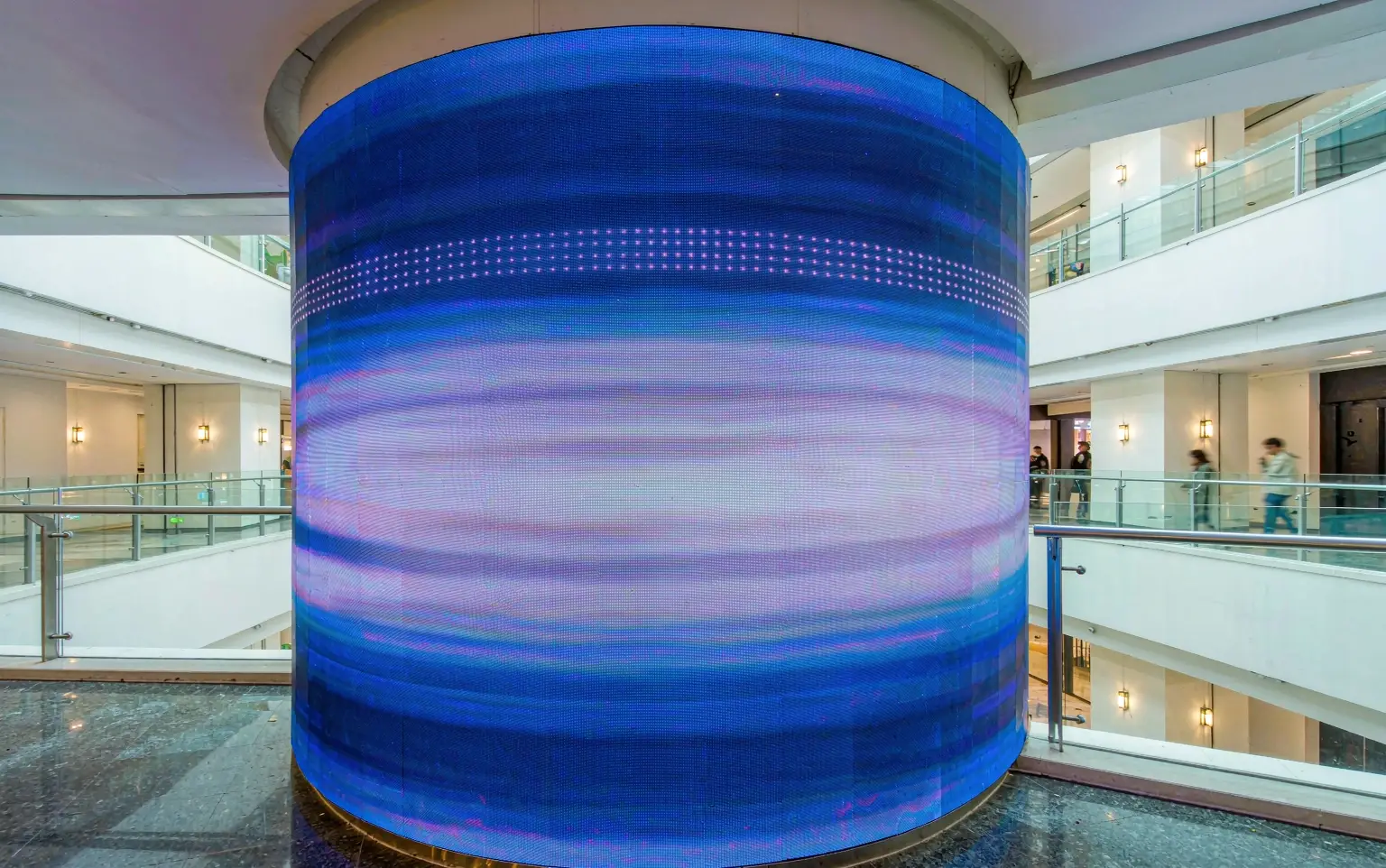
A shopping mall needed a screen wrapped around a round column. The design was simple: one arc, 1.2 m radius, 4 m tall.
The installation crew did what they always do. They built it from standard 500 × 500 mm cabinets. What they got was a twelve-sided polygon. From across the atrium it looked fine. Up close, you could count the corners — and at every corner the seams refused to line up. In daylight they read as a row of broken white lines.
The job stopped for three weeks: new drawings, new pricing, strip it out and start again. The client withheld 15% of the final payment.
The crew did nothing wrong, and rigid cabinets are a good product. The mistake was earlier than that: on a curved requirement, someone specified a product that can only travel in straight lines.
That is the entire reason an LED flexible screen exists. The screen should not be redesigned to suit the product.
2. What an LED flexible screen really is: 3 parts, 6 specs
2.1 Three parts decide whether it bends at all
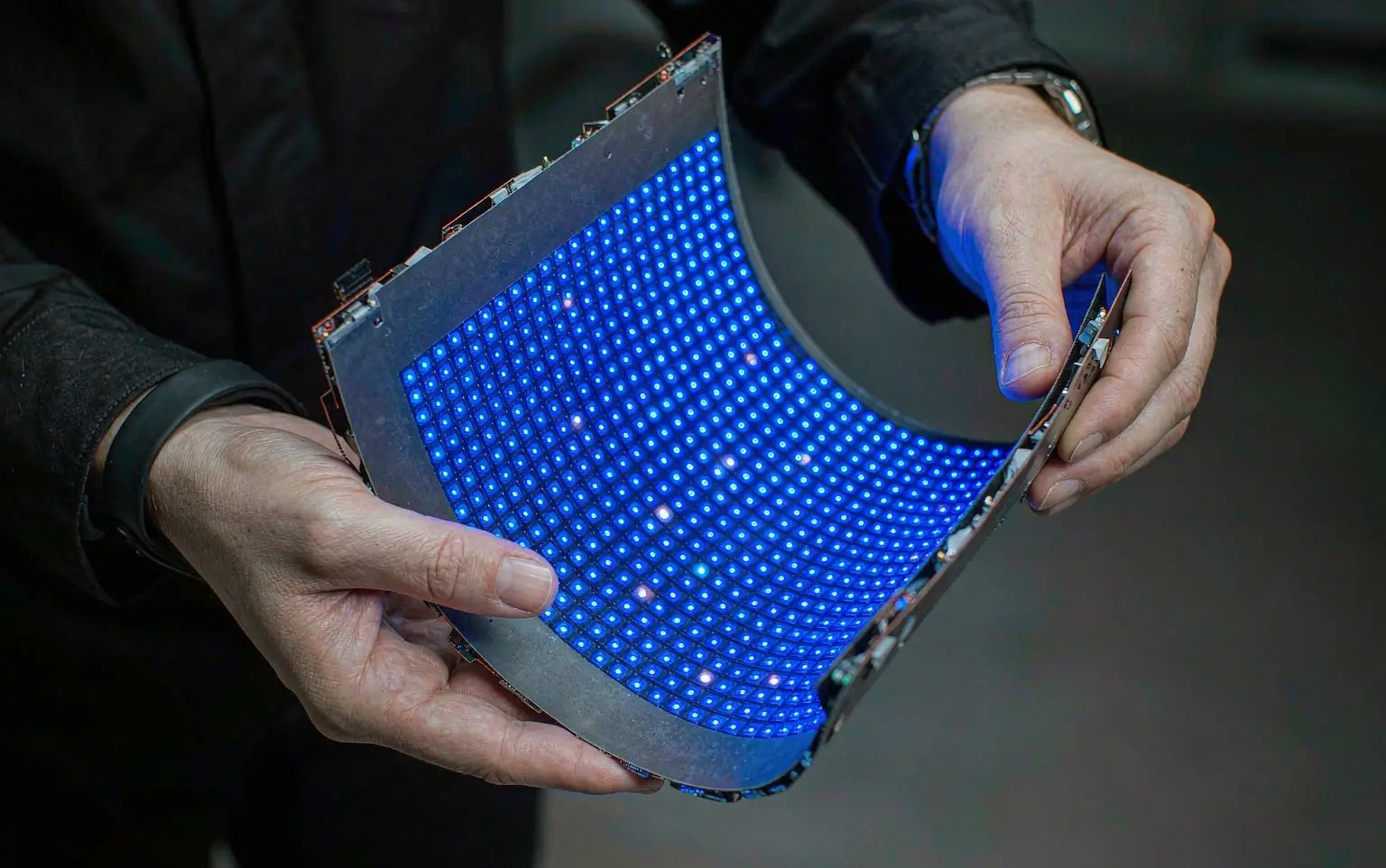
People hear "flexible" and picture a sheet of fabric. It is not. It is still a precision electronic assembly — but three components that are normally rigid have been replaced:
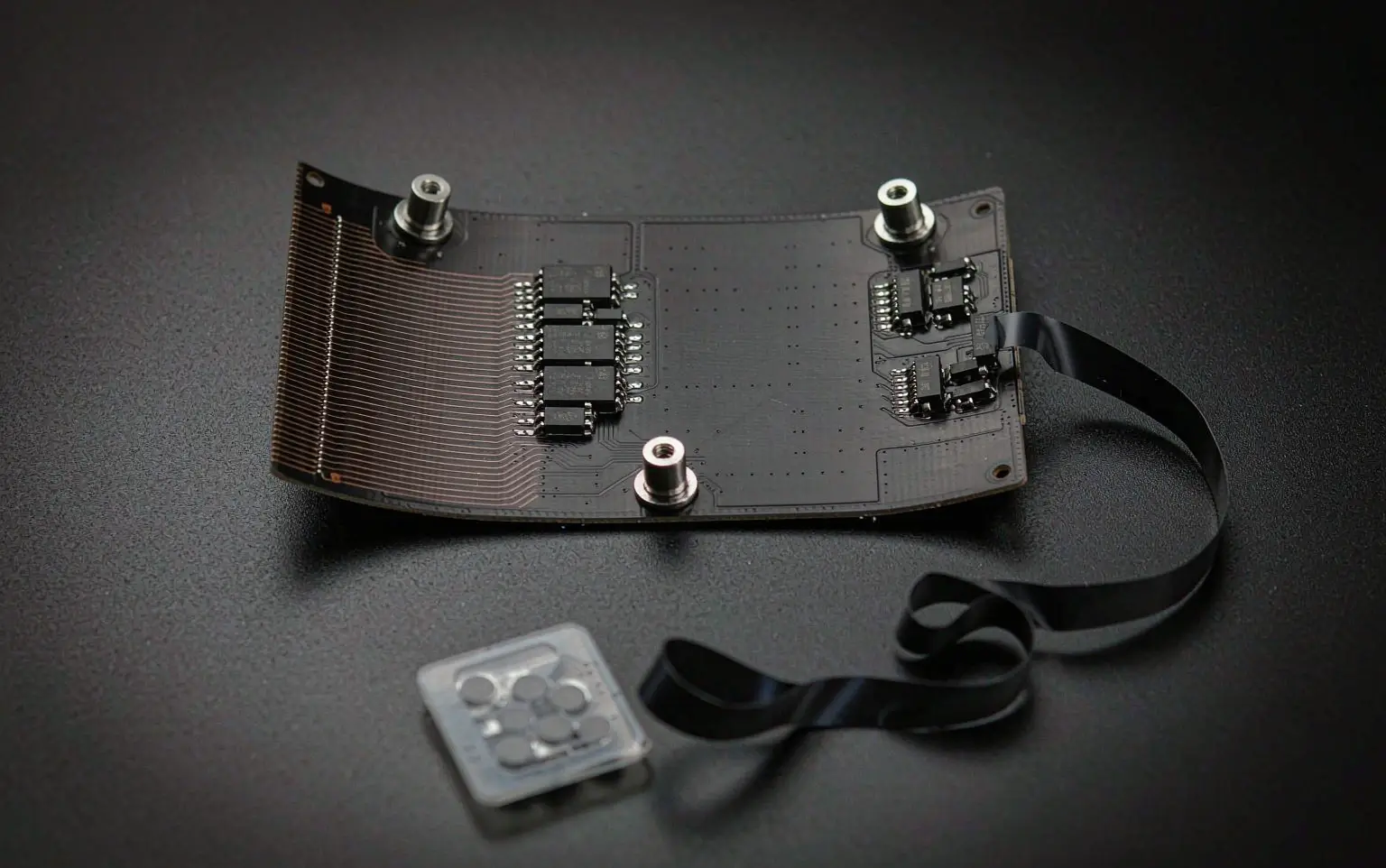
- Flexible PCB substrate — the circuit is built on a thin bendable base instead of a rigid FR4 board.
- Soft encapsulation — LEDs and driver ICs are sealed in silicone or flexible resin, so bending does not shear the solder joints.
- Magnetic mounting system — modules attach to the curved steel frame with magnetic studs rather than screws driven one by one.
All three have to be flexible. Replace only one and the module will fail after a couple of bend cycles. This is the real reason cheap flexible modules die in the field.
2.2 Six specs decide how well it bends
| Spec | Typical industry range (indicative) | What it changes on site |
|---|---|---|
| Minimum bend radius | 0.5 – 2 m | Decides whether it can follow the real curve; tighter radius means harder process |
| Pixel pitch | P1.25 – P4 | Tighter radius usually forces a larger pitch — lower the resolution expectation |
| Brightness | 800 – 6000 cd/m² | Indoor 800–1500; semi-outdoor 3000–5000; direct sun needs more |
| Refresh rate | ≥ 1920 Hz | No banding on camera; mandatory for broadcast, film and live streams |
| Ingress protection | IP40 indoor / IP65 outdoor | Outdoor needs potting or conformal coating plus drainage and thermal paths |
| Weight per m² | 5 – 10 kg/m² | 30%–50% lighter than rigid cabinets — directly cuts steel frame cost |
2.3 Six shapes it unlocks
A full turn around a round column with a continuous surface and no corners. The classic use case, and the easiest to sign off.
Mounted onto an existing concrete arc or curved soffit. Large radius, large area — biggest structural savings.
Deliberate undulation across one surface, created by varying the radius. Practically impossible with rigid cabinets.
Trunk, branches, organically shaped bodies. This design freedom is where the project margin actually comes from.
Turns a 90° room corner into a continuous arc and removes the colour shift and hard break at the joint.
Low weight and roll-able transport suit the rig-and-strike rhythm of touring productions.
3. From drawing to first light: 6 steps
Flexible projects rarely fail because of the screen. They fail because the steps were taken in the wrong order — usually "choose the module, then design the frame." Do it the other way round: confirm the building's real arc first, then work back to the module and the structure.
Steps 2 and 3 are the pair people invert. Choosing the module first forces the steel frame to accommodate the product; designing the frame first forces the product to accommodate the building. The first route is where rework comes from.
4. Flexible screen vs rigid cabinet vs pre-bent module
There are three ways to build a curved display, and none of them is universally better — only more or less suitable. Pick the wrong one and every later decision becomes damage control.
5. Why a small bend radius gets expensive fast
Flexible screen pricing is not a straight line — it is a curve. Going from a 10 m radius to 5 m barely moves the number. Going from 1 m to 0.5 m can double it.
The reason is structural. A tighter radius means each module has to be cut smaller, which multiplies joints, driver channels and frame tolerance requirements — and pushes up the reject rate with them. The practical rule: measure the building's real arc radius, then add 20% headroom before choosing the module. Do not design against the theoretical limit.
6. The module costs 20–35% more. Total cost often drops.
When buyers see the module price, the reaction is usually "expensive." That reaction is only half right — a flexible screen is expensive in the module, and cheap in everything around it.
| Cost item | Rigid cabinet approach | LED flexible screen approach |
|---|---|---|
| Screen & modules | Baseline | Roughly 20%–35% higher |
| Curved steel frame | Polygon frame, heavy material and machining | Simpler frame, less steel, less weight |
| Site labour | Seam by seam, long programme | Magnetic mounting, fast build |
| Rework risk | Corners and seam drift are likely | Continuous surface, low rework |
| Pricing headroom | Commodity, easy to compare on price | Design capability supports premium pricing |
7. When to specify an LED flexible screen
- Cylindrical column wraps, curved columns, room corners
- The building already has an arc and must not be redesigned
- Wave, ribbon or sculptural shapes
- Touring or rental builds needing roll-able transport and fast strike
- You want design capability as a differentiator and premium pricing
- Large flat billboard positions bought purely on price per m²
- Standard 16:9 video walls and meeting-room screens
- A single arc, one-off, very low volume
- Squeezed budgets on signage where schedule is not critical
- No local capability to fabricate and true up a curved steel frame
8. Six things to nail on an export order
The difference between exporting a flexible screen and exporting a rigid one sits in the second half of the project: packing, spares and site support. Get that wrong and the price advantage you won on disappears in after-sales.
- Packing method. Ship flexible modules half-rolled or flat and reinforced. Never store them long-term at the minimum radius. Reinforced wooden crates beat standard cartons on long sea freight.
- Transport curvature. The curve inside the crate must be larger than the module's minimum bend radius, not equal to it. That headroom is what stops vibration from reaching the solder joints.
- Spares ratio. Plan around 2%–3% spare modules and 5% spare power supplies. Air-freighting a single replacement to an overseas site costs far more than shipping spares upfront.
- Electrical standards. Confirm voltage, frequency and plug type for the destination market, and design the power supply with derating. Hot-climate markets in particular need the operating temperature range checked.
- Tools and lifting rigs. Magnetic mounting needs suction lifters to place modules. Do not leave that as "client to provide" — ship the tools with the order and you save a week of email.
- Calibration and remote support. Hand over the point-by-point calibration log, a lit-up video and the cable routing plan, and keep a remote commissioning channel open. Most acceptance disputes die right there.
9. The five most common mistakes
Pricing the job as if it were flat — screen plus installation — and treating steel separately. By the time the frame quote arrives the margin is gone. Curved frame fabrication has to be in the total from day one.
The figure on the datasheet comes from controlled lab conditions. Real steel frames carry fabrication tolerance, and the two stack up into local over-bending and a rippling surface. Keeping 20% headroom is the cheapest insurance in the trade.
Cable routing around a curve and up a column is more complex than on a flat wall, so zoning has to be planned up front. The larger the blast radius of a single failure, the harder the site repair.
People walk closer to a curved screen than to a flat one — the shape itself pulls them in. Specify pitch against the closest viewing distance, not the average.
A flexible build typically has more panel units than a flat screen of the same area, so colour and brightness deviations are easier to spot. Point-by-point calibration, aging and a recorded video are the cheapest acceptance protection you can buy.
10. Key takeaways
If you only have three minutes, these eight points are enough to judge how a curved project should be built.
| # | Takeaway |
|---|---|
| 1 | Bend radius is the cost divider. Common modules reach 0.5–1 m; tighter costs more. Design with 20% headroom. |
| 2 | Flexibility comes from three parts. Flexible PCB, soft encapsulation and magnetic mounting — replace only one and it fails within a few bend cycles. |
| 3 | Pixel pitch follows the radius. A tight radius usually means a larger pitch, so do not copy the pitch from a flat project. |
| 4 | Judge total cost, not module price. Modules run 20%–35% higher while steel and labour often fall by more than 30%. |
| 5 | The structure matters as much as the screen. Frame accuracy decides the final seams — design the frame before locking the module. |
| 6 | Outdoor starts with IP and thermal design. IP65 plus potting plus drainage, and check power derating for hot markets. |
| 7 | Build in redundancy. No single cable or power supply failure should black out a whole section. |
| 8 | Never ship without burn-in and calibration. 72 hours of aging plus a recorded video removes half of all acceptance arguments. |
Frequently asked questions
What is the main difference between an LED flexible screen and a standard LED display?
The difference is in the substrate, the encapsulation and the mounting method. A standard display uses rigid cabinets and fasteners; a flexible screen uses a bendable substrate, soft encapsulation and magnetic mounting, which is what lets it follow arcs, cylinders and irregular structures. The trade-off is that modules of comparable specification usually cost 20%–35% more, and the premium climbs as the bend radius tightens.
How much does an LED flexible screen cost, and how much more than a rigid screen?
The typical industry range is 20%–35% above a rigid screen at the same pixel pitch, and it depends on bend radius, pitch and ingress protection. Total cost matters more than module price: on a curved project the flexible route often eliminates a large share of curved steel fabrication and seam-tuning labour, so the gap in overall build cost is usually far smaller than the gap in module price.
How tight can the bend radius be, and is tighter always better?
Common flexible modules achieve a minimum bend radius of 0.5–1 m, and special constructions can go tighter. A tighter radius means smaller module units, higher structural demands, and both cost and failure risk rise with it. The practical approach is to confirm the building's real arc radius first, then add 20% headroom when selecting the module rather than designing against the theoretical limit.
Can a flexible LED screen be used outdoors, and which IP rating do I need?
Yes. Outdoor installations normally require IP65, along with potting or conformal coating and a structure that handles drainage and heat. Indoors, IP40 is usually sufficient. For hot and humid export markets such as the Middle East, also confirm the operating temperature range and the power supply derating design — those two get overlooked far more often than the IP rating.
What should I watch out for in shipping and on-site installation?
For shipping, pack flexible modules half-rolled or flat and reinforced so they never sit at a small radius for long periods, and plan spares at 2%–3% of modules and 5% of power supplies. For installation, fabricate and true up the curved steel frame first, then place modules with suction lifters rather than by hand. Handing over the point-by-point calibration log and a lit-up video at the same time makes site acceptance considerably smoother.
Got a curved, cylindrical or custom project on the table?
Send us the arc radius, screen dimensions and mounting structure. We will come back with the achievable pixel pitch range, a recommended bend radius and an indicative cost band within 48 hours.
Request a flexible screen quote →
Original technical write-up. Figures quoted are typical industry ranges intended to frame a specification decision; they are not performance guarantees or quotations. Always confirm against the project specification, factory test report and measured data.
XINGSHI LED · COB LED Display & LED Flexible Screen Solutions