LED Screen for Advertising: How to Buy One That Actually Earns Its Money Back
Two operators spend the same money. One recovers it in a year and sells out inventory; the other owns a giant TV nobody can read at noon. The difference is rarely the price — it is the handful of questions asked before signing.
- A real rework story: the screen was never the problem
- What a good LED screen for advertising really has to deliver
- Five specs that decide whether your money is well spent
- Outdoor and indoor are two different businesses
- Doing the math: how long until payback?
- A six-step procurement checklist
- Key takeaways
- Frequently asked questions
1. A Real Rework Story: The Screen Was Never the Problem
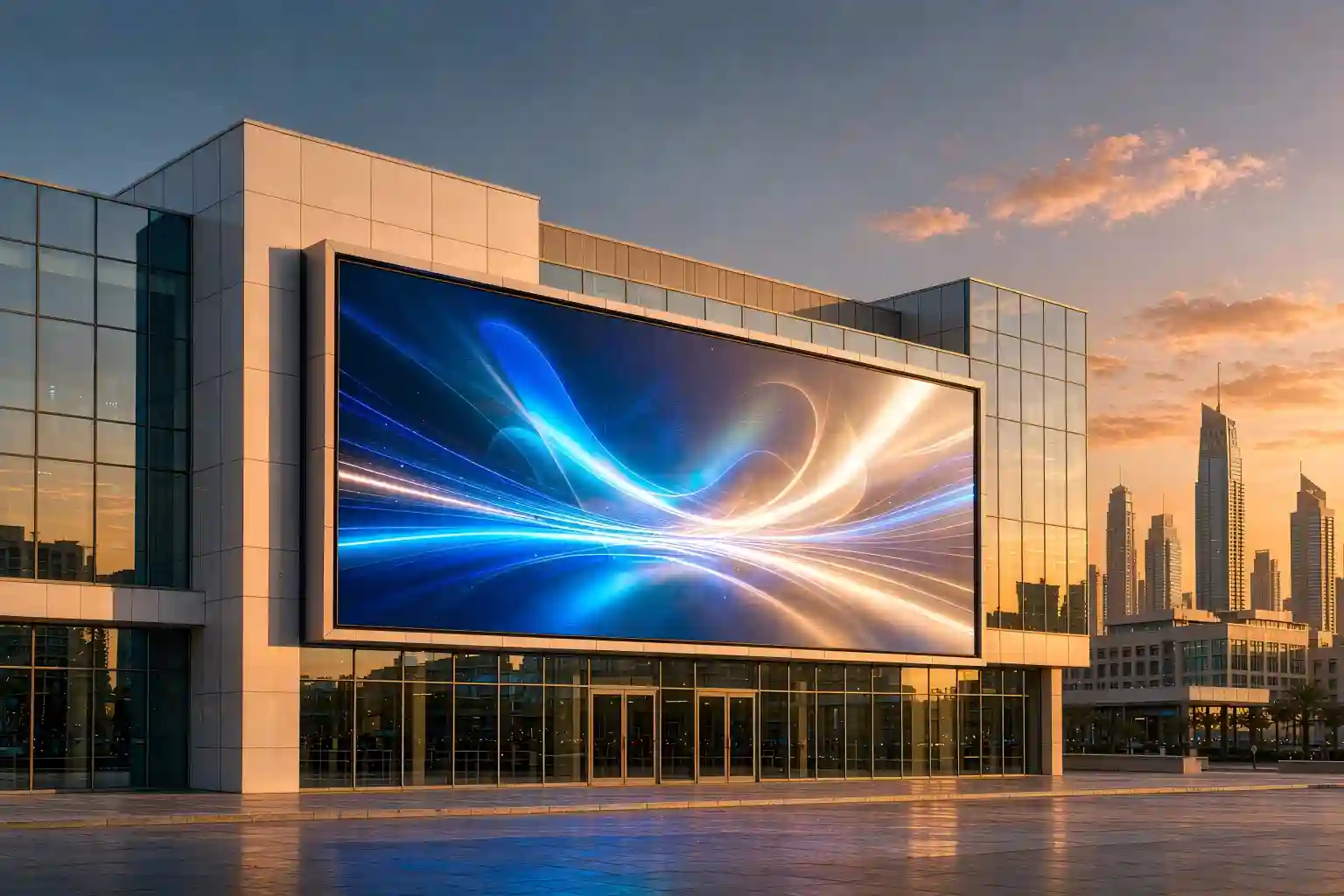
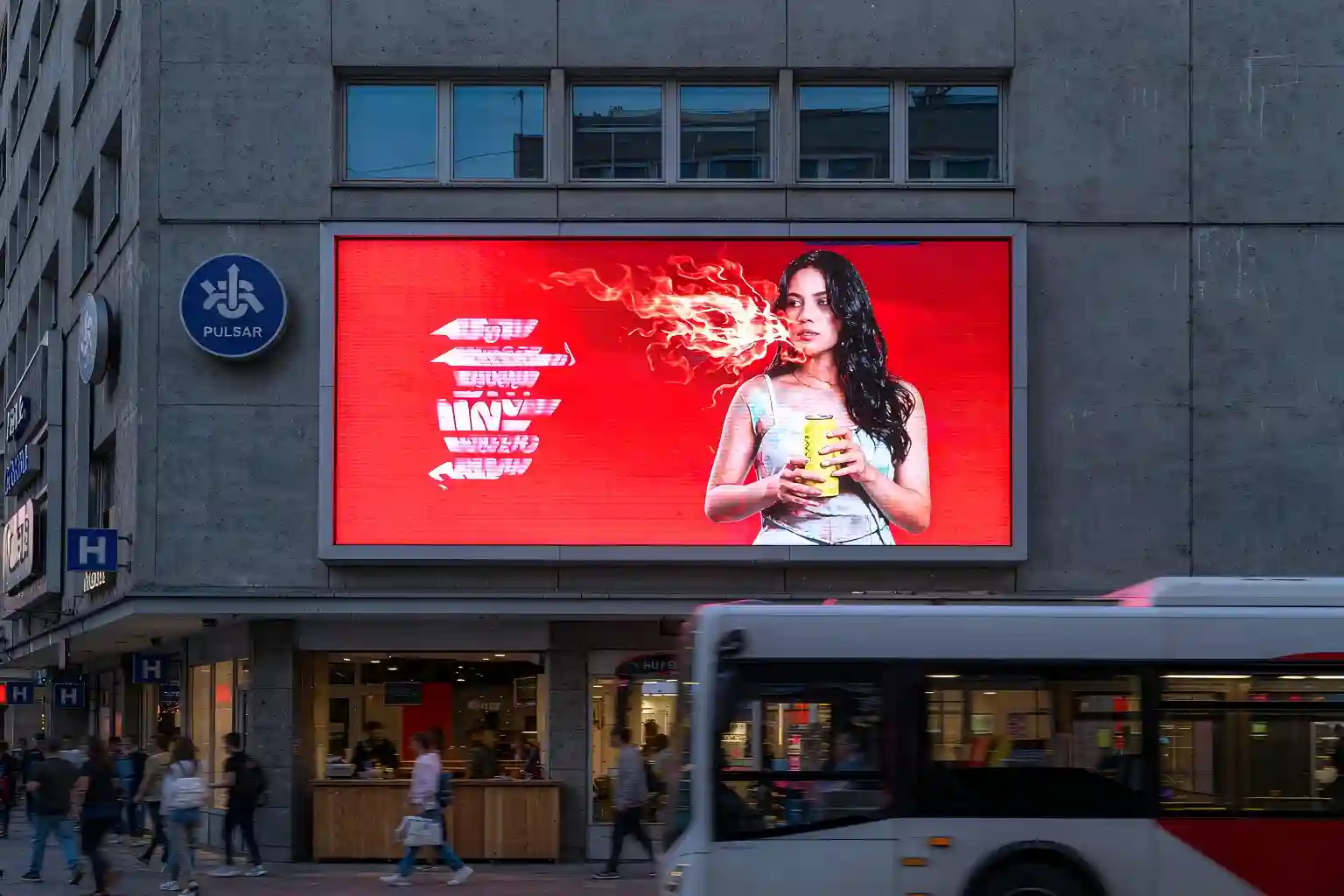
Last year a media operator mounted an outdoor LED screen for advertising on a downtown rooftop. For three months it performed beautifully — advertisers were lining up to sign. Then the rainy season arrived. A faint dark patch appeared in the lower right corner, and within six months it had spread into a full module of colour shift.
His first assumption was that the supplier had short-changed him. But when the cabinet was opened, the modules were fine. The real cause was the installation: no clearance for heat to escape and no drainage slope on the frame. Moisture pooled at the bottom of the enclosure for months and slowly corroded the lamp pins.
Stories like this are the norm rather than the exception. The final performance of an LED screen for advertising is roughly half the panel and half everything around it — the mounting environment, the content brightness, and how it is maintained. Yet almost all the attention goes to the quotation.
2. What a Good LED Screen for Advertising Really Has to Deliver
Set the spec sheet aside for a moment. The commercial value of an LED screen for advertising comes down to three plain questions: can people see it, will it last, and is it worth the rate card?
Can people see it — this decides whether the ad is ever read
Advertising is bought for exposure. If the panel washes out in midday sun, or pedestrians three metres away see nothing but a smear of light points, you have bought an expensive decorative object. Three specs govern this: brightness, contrast and pixel pitch.
Will it last — this decides your annual cost of ownership
An advertising screen is a long-life asset, typically expected to serve five to eight years. The same investment amortises to less than half the annual cost over eight years versus three. This is governed by LED quality, power supplies, thermal design and front-versus-rear service access.
Is it worth the rate card — this decides whether advertisers renew
At the same location, a clean, colour-accurate screen supports a higher rate card. A washed-out one with visible colour shift has to be discounted to sell. This is governed by refresh rate, grey scale depth and point-by-point calibration.
Four Stages From Content to Light
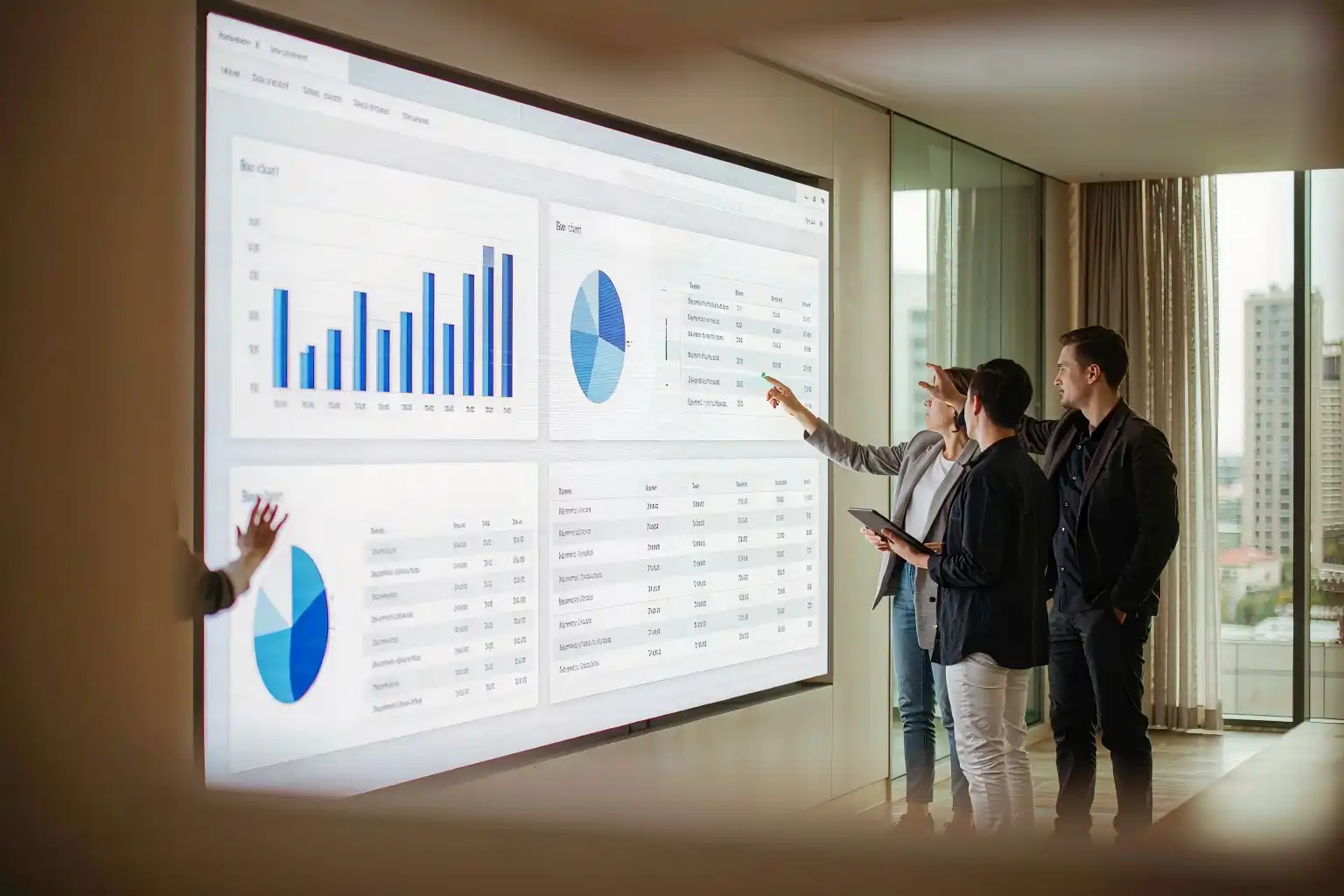
The diagram below breaks an LED screen for advertising down from content file to visible pixel. Understanding the chain tells you where to look when something goes wrong — most "the screen is broken" calls turn out to be a content or signal problem.
3. Five Specs That Decide Whether Your Money Is Well Spent
A spec sheet runs to dozens of lines, but only five of them materially change the commercial performance of an LED screen for advertising. Understand these and you can tell which line items in a quotation to pay for — and which to challenge.
1. Brightness (nits) — start by asking whether you sell in daylight or at night
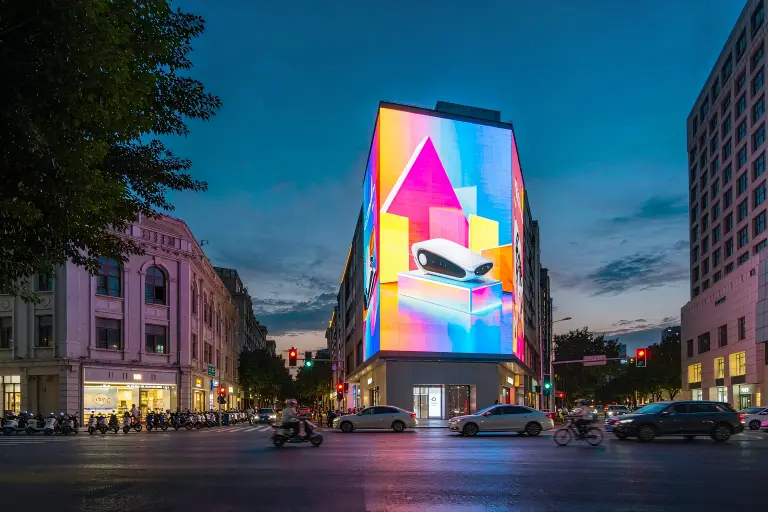
Brightness determines the conditions in which the screen can be read. A facade facing direct sun typically needs 5000–7000 nits; a north-facing or predominantly night-time site is well served by 4000–5000 nits. Do not chase peak brightness. Over-specifying raises cost, pushes up electricity bills, ages the LEDs faster, and invites complaints about glare after dark.
2. Pixel pitch — work backwards from viewing distance, not from gut feel
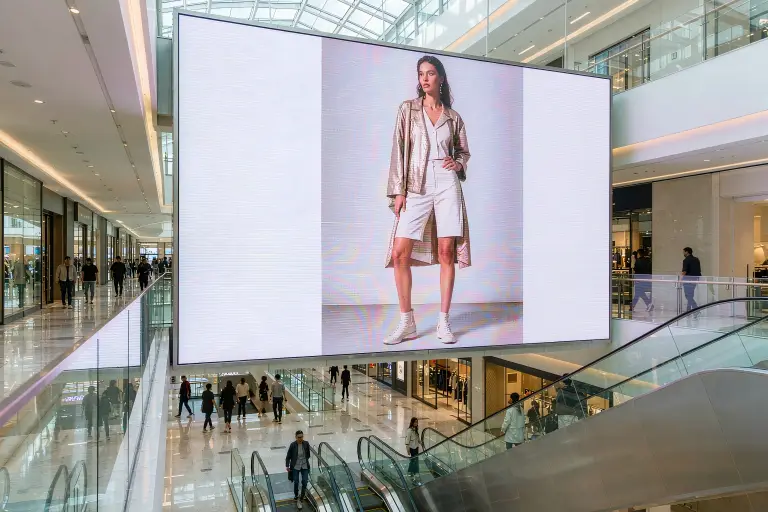
Pixel pitch is the distance between adjacent LEDs in millimetres. Smaller means finer detail and a higher price. A useful rule of thumb: comfortable viewing distance (metres) ≈ pixel pitch (mm) × 1 to 1.5. A street panel whose nearest realistic viewing distance is around 10 metres is fine at P8–P10. A shopping mall atrium where people stand three metres away calls for fine-pitch P2.5–P4.
3. Cabinet design and service access — this sets your repair bill for the next eight years
This is often a single line on a quotation and the largest long-term cost of all. For outdoor advertising, confirm whether the screen supports front service access. If modules can only be removed from the rear, then the higher you mount the screen and the closer it sits to the wall, the more painful every future module replacement becomes.
4. Refresh rate and grey scale — how advertisers judge picture quality
Below 1920 Hz, on-camera shots show obvious black banding — a serious problem for ad shoots and live-streamed store tours. Mainstream advertising screens should start at 1920 Hz, with 3840 Hz available for premium projects. Grey scale depth governs shadow detail at night; 14-bit and above is a sensible baseline.
5. Point-by-point calibration — the most skipped step that most affects your rate card
LEDs from the same batch still vary in brightness and chromaticity, and once assembled that variance reads as a patchwork quilt. Point-by-point calibration measures and corrects every individual LED, flattening uniformity across the whole panel. A calibrated screen looks clean and holds its rate card; an uncalibrated one drifts visibly worse within a year.
Quick selection reference by application
| Application | Brightness | Pixel pitch | Priorities |
|---|---|---|---|
| Outdoor street / rooftop | 5000–7000 nits | P6–P10 | IP rating, thermal design, front access, wind loading |
| Outdoor pylon / kiosk | 4500–6000 nits | P4–P8 | Low power draw, automatic night dimming |
| Mall atrium / indoor ads | 800–1500 nits | P2.5–P4 | Seam consistency, grey scale, calibration |
| Storefront / lift lobby | 600–1200 nits | P1.5–P2.5 | Slim cabinets, close-range sharpness |
| Cinema / showroom backdrop | 600–1000 nits | P1.2–P2 | High refresh, HDR support, silent cooling |
Note: figures above are typical industry ranges for illustration. Final selection depends on viewing distance, budget and site conditions.
4. Outdoor and Indoor Are Two Different Businesses
Procurement teams often ask why outdoor and indoor quotations for what looks like the same LED screen for advertising differ so widely. The answer is that the two products fight entirely different enemies.
- Outdoor screens fight the environment — sunlight, rain, salt air, temperature swings and wind loading. They need IP65 sealing, UV-stable masks, robust thermal paths and reinforced steelwork. The money goes into the enclosure and the structure, not the panel.
- Indoor screens fight distance — the audience stands close enough to see individual LEDs. They need tighter pixel pitch, deeper grey scale, higher refresh rates, stricter point-by-point calibration and near-silent cooling. The money goes into precision and tuning.
- The business models differ even more — outdoor screens monetise through rate cards and location scarcity, making the panel a heavy asset; indoor screens are usually a footfall and brand tool, judged on store visits and dwell time.
5. Doing the Math: How Long Until Payback?
This is the question every buyer of an LED screen for advertising should ask and almost none does. It needs no financial model — just four numbers.
- Total investment (A)Cabinets, control system, steelwork, installation and permits. Many projects budget only the panel and overshoot by thirty per cent.
- Annual operating cost (B)Electricity (average power draw × daily hours × tariff), content production and maintenance. Outdoor electricity is routinely underestimated.
- Annual advertising revenue (C)Sellable slots × rate card × realistic sell-through. Sell-through is often only 60–80% — do not model full occupancy.
- Payback ≈ A ÷ (C − B)A healthy range in the industry is roughly two to four years. Beyond five, the location or the pricing needs rethinking.
6. A Six-Step Procurement Checklist
Work through these six actions and the odds of a costly mistake on your LED screen for advertising drop sharply.
- Describe the site before asking for a priceMounting position, nearest and farthest viewing distance, sun direction, daily operating hours and whether front access is needed — send that paragraph to the supplier.
- Ask for a sample or photos of the same model in the fieldDo not accept renders alone. Request images or video of that exact model in a similar environment, and see a screen in person if you can.
- Fix the calibration standard in the contractWrite in acceptance limits for brightness uniformity and chromaticity uniformity, and confirm whether calibration data files are supplied with the screen.
- Confirm the control system and content workflowSender and receiver card brands, playback software, remote publishing, scheduled power on/off and automatic brightness adjustment.
- Agree a spares ratioTypically 2–5% spare modules and power supplies by module count, plus a defined replenishment lead time.
- Run a three-step on-site acceptanceSolid-colour test (check dead pixels in red, green, blue and white) → grey-scale gradient test (look for banding and uniformity) → 24-hour continuous run (check power and thermal stability).
7. Key Takeaways
If you remember only one page, make it this one.
| Point | Takeaway |
|---|---|
| What it really is | An LED screen for advertising is production equipment. Judge it on revenue per dollar invested, not price per square metre. |
| Three deliverables | See it (brightness, contrast, pixel pitch), keep it (LEDs, PSU, thermal, service access), sell it (refresh rate, grey scale, calibration). |
| Brightness | Pitch per application: 5000–7000 nits facing sun outdoors, 4000–5000 nits shaded or night-led, 800–1500 nits indoors. Never over-specify. |
| Pixel pitch | Comfortable viewing distance (m) ≈ pitch (mm) × 1–1.5. Work backwards from the audience, not from the brochure. |
| Most commonly skipped | Point-by-point calibration. It sets visual uniformity and therefore your rate card and renewals. |
| Most underestimated cost | Service access and spares. For outdoor installs, insist on front access. |
| Payback formula | Payback ≈ total investment ÷ (annual advertising revenue − operating cost); a healthy range is about two to four years. |
| Outdoor vs indoor | Outdoor competes on structure and protection, indoor on precision and tuning. One specification cannot serve both. |
8. Frequently Asked Questions
Q1: What mainly determines the price of an LED screen for advertising?
Pixel pitch, brightness, LED brand and cabinet construction. Tighter pitch delivers finer detail at a higher cost, so the right sequence is to fix pixel pitch from your viewing distance first, then weigh brightness, ingress protection and calibration standard, and only then compare prices. Comparing cost per square metre in isolation usually leads to a mismatched specification.
Q2: Is higher brightness always better for an outdoor LED screen for advertising?
No. Brightness only needs to match ambient light. An outdoor screen facing direct sun is typically well served by 5000–7000 nits. Over-specifying raises purchase cost, increases electricity consumption, accelerates LED ageing, and can create light pollution and neighbour complaints after dark. Choose a solution that supports time-based automatic brightness adjustment.
Q3: How long does an advertising screen take to pay for itself?
Estimate it with payback ≈ total investment ÷ (annual advertising revenue − annual operating cost). Total investment must include the panel, control system, steelwork, installation and permits; operating cost is mainly electricity and maintenance. A healthy range in the industry is roughly two to four years, and anything beyond five years suggests the location value or the rate card needs re-evaluating.
Q4: How do I judge the picture quality of an LED screen for advertising?
Look at three things: uniformity, meaning whether a solid white field shows visible patches or dark corners; refresh rate, meaning whether a phone camera reveals black banding; and grey scale, meaning whether shadow areas break into visible steps. These three map directly onto point-by-point calibration, driver design and high grey-scale processing, and they are exactly what advertisers notice first.
Q5: Does an outdoor advertising screen have to support front service access?
It is strongly recommended. Front access means modules can be removed and replaced from the front, with no rear maintenance corridor required — particularly important on rooftops, street facades and wall-mounted installations. With rear-only access, the higher the screen is mounted and the closer it sits to the wall, the greater the labour and rigging cost of every future module replacement, and the long-term maintenance bill can easily exceed the difference you saved up front.
Send us your installation details and get a specification recommendation
Tell us the location, viewing distance, sunlight conditions and daily operating hours. We will come back with a matching pixel pitch, brightness and cabinet proposal, with a payback estimate.
Get my LED screen for advertising recommendation
This is original content. All brightness, pixel pitch and payback figures are typical industry ranges used to illustrate the selection logic; confirm actual projects against supplier specifications, on-site measurements and contract terms.
Keywords: led screen for advertising, LED advertising screen, outdoor LED screen for advertising, led screen for advertising price, pixel pitch, LED screen brightness, point-by-point calibration, digital billboard.