Tri Fold LED Display: How to Get Hinges, Corner Seams and Calibration Right
You are specifying a screen for a downtown building corner, a touring rental fleet, or a museum entrance. Two quotes sit on your desk. One is a conventional flat-panel build with a corner trim piece. The other is a tri fold led display. The price gap looks small. The gap in picture consistency and field repair rate two years from now usually is not.
This guide walks through the tri fold led display from an engineer's point of view: what the two commercial forms actually are, how the hinge carries load, how to control the seam where three panels meet, and why calibration of a foldable LED display is a staged process rather than a single factory pass. It is written for anyone specifying an LED display for advertising — and for the contractors who have to defend that choice at bid review. Numbers throughout are flagged as typical ranges or illustrative figures; your project specification and as-built measurements always govern.
On this page
- 1. What a tri fold led display actually is: two commercial forms
- 2. Why it beats "flat panels plus corner trim"
- 3. How the hinge carries load: spec, back frame and lock
- 4. Corner seam control: physical, optical and perceptual seams
- 5. Multi-stage calibration: making three panels read as one
- 6. Why COB packaging suits a folded picture
- 7. Shipping volume, steelwork and lifecycle math
- 8. Flat panel vs tri fold LED video wall: comparison table
- 9. FAQ
1. What a tri fold led display actually is: two commercial forms
The keyword carries genuine ambiguity in this industry. In procurement conversations it almost always means one of the two products below. Confirming which one your supplier is quoting saves most of the back-and-forth later.
Form A — foldable LED display
Cabinets are joined by hinges or a folding mechanism, and the wing modules swing through 0–180°. The value is shipping volume, fast on-site deployment, and the ability to form an inward or outward corner. Rental fleets and exhibition builds use this most.
Form B — 3 panel LED display at a corner
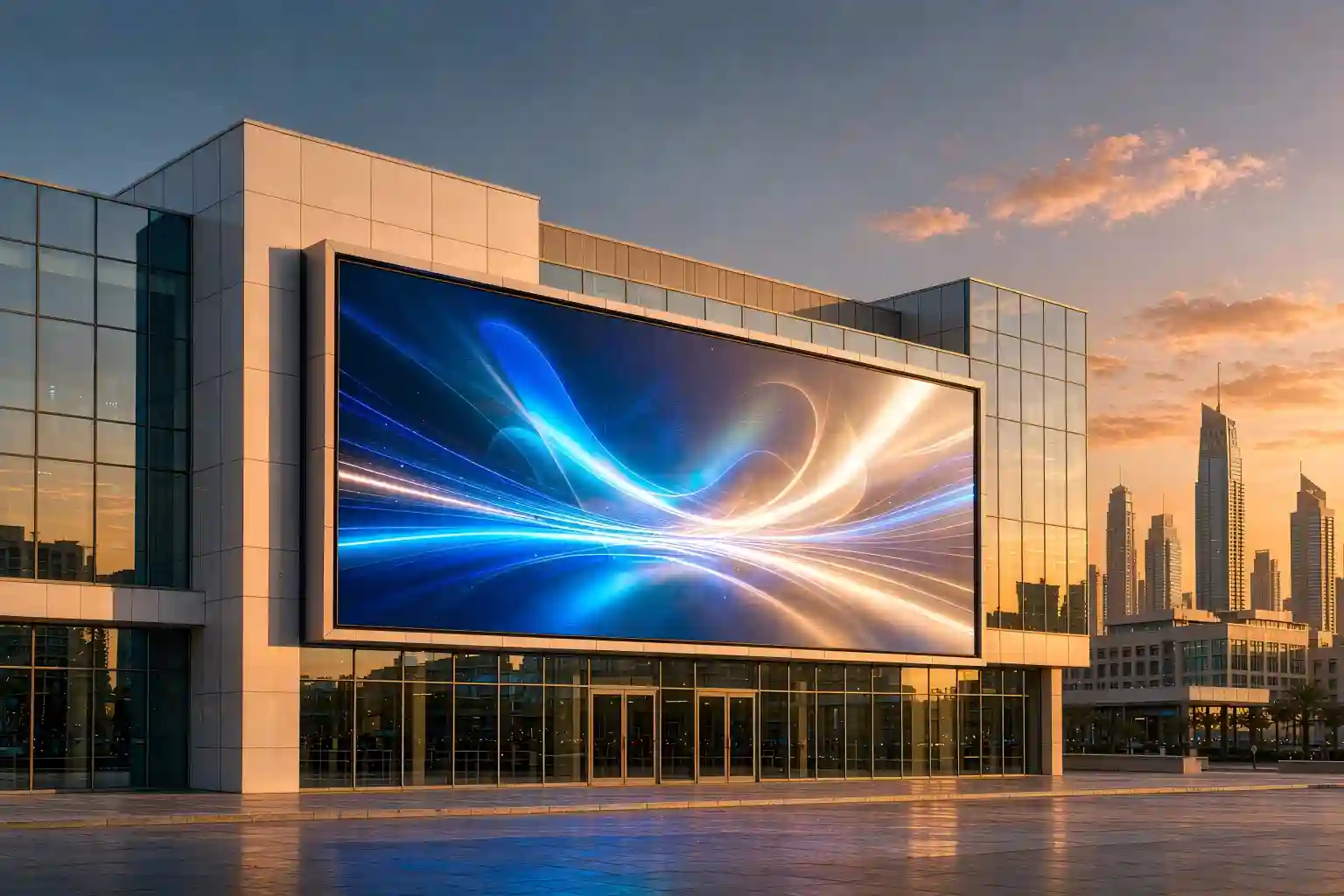
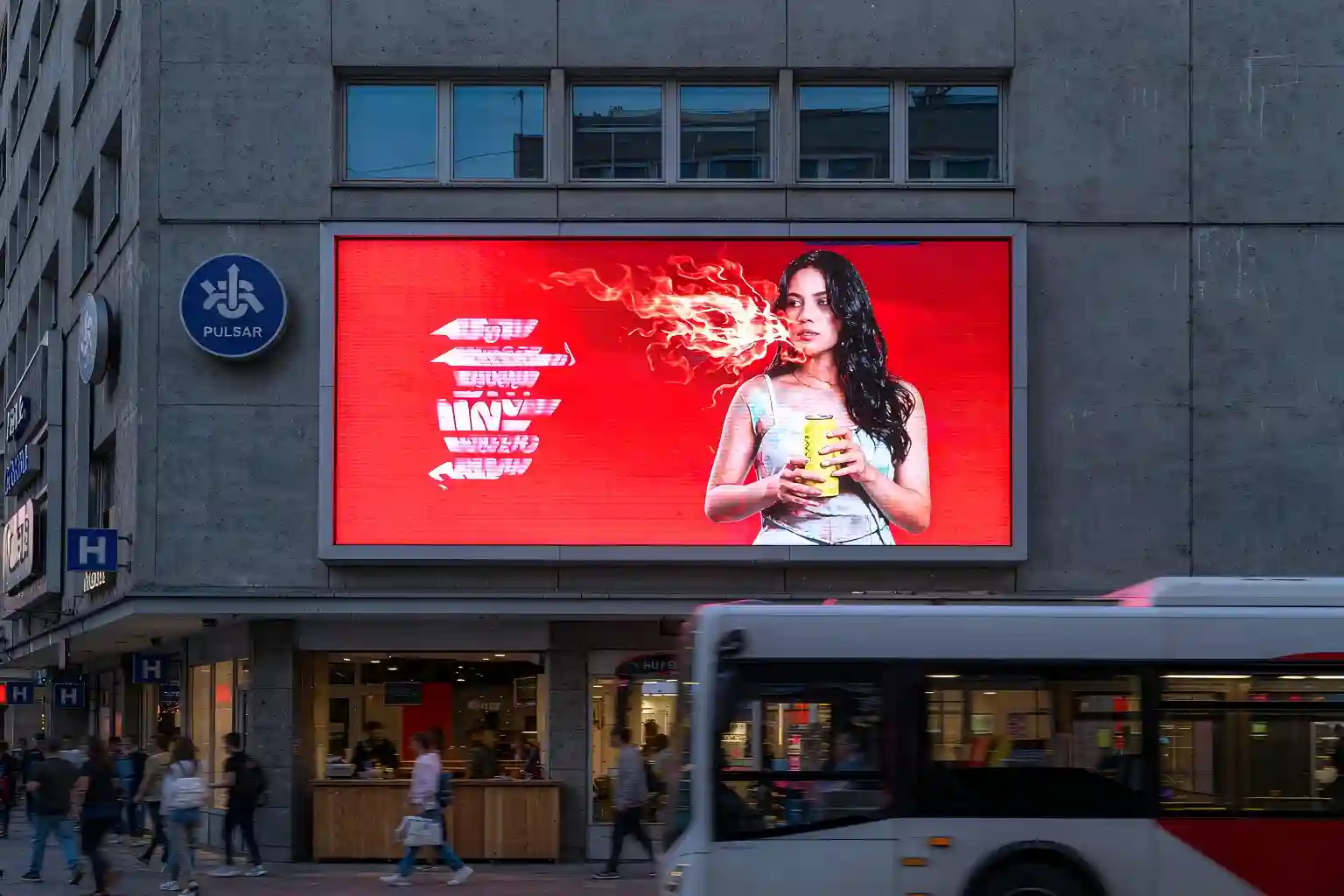
Three panels are assembled at 90° (or in an L or U shape) around a building corner. The content uses perspective offset to produce a naked eye 3D effect. Downtown corner advertising is the classic application.
Both forms share the same underlying engineering: module structure, power and signal routing, receiving cards and the calibration system are common ground. That is why one article covers both, and why the practical selection order is: decide the form, then the cabinet, then the calibration plan.
Form A is not about folding — it is about staying aligned after folding
Plenty of suppliers describe a tri fold led display as "it folds, therefore it works." From an engineering standpoint folding is only the entry ticket. Three things decide whether the project succeeds: whether module flatness survives repeated open-and-close cycles, whether the wing locks to the intended angle on the first attempt, and whether the pixel mapping across the fold is stable and repeatable. Skip any of the three and the folded zone becomes a visible band of brightness and colour steps once the screen is deployed.
Put differently, the price spread between two foldable LED display quotes rarely lives in the LEDs or the driver ICs. It lives in hinge specification, back-frame stiffness, and the factory calibration pass done with the fold closed and open. The next section takes those apart.
2. Why it beats "flat panels plus corner trim"
The traditional way to build a corner advertising position is two ordinary outdoor LED display cabinets, hard-joined at the corner, with a black trim strip covering the gap. It is cheap to build and carries three running costs:
The corner gap is unpredictable
Installation tolerances on two independent cabinets compound at the corner. Depending on steelwork flatness, gap deviation typically lands in the 2–6 mm range — a dark line head-on, a bright edge from an angle, and especially obvious in direct outdoor sunlight.
Each panel is calibrated on its own
When the two screens sit under separate receiving cards, brightness and chroma references are independent, and a perceptible colour step appears across the corner. This is the complaint advertisers voice first.
Shipping volume stays fixed
Flat cabinets ship as one rigid package, and their size is limited by the flight case. A tri fold led display screen folds its wings flat, so the same display area occupies less cargo space — decisive for rental projects that move repeatedly.
A three-panel corner build resolves all of this at the factory: one mechanism fixes the angle, one calibration strategy sets a common reference on both sides, and the screen ships folded as a single unit. That is why the unit price of a tri fold led display usually exceeds a comparable flat panel, while total cost of ownership often does not.

3. How the hinge carries load: spec, back frame and lock
This is the part of a tri fold led display that is easiest to copy cosmetically and easiest to get wrong in service. Follow the load path from the top down.
Figure A: the load path through the folding mechanism. The hinge both locates the wing and transfers force, which makes it the most likely failure point in a foldable build.
3.1 Hinge: "how far it rotates" is the wrong first question
Suppliers like to quote a rotation range such as 0–180°. The four figures that actually matter:
- Rated load and safety factor. A single hinge carries the wing's own weight plus the bending moment the wind load delivers through the frame. For outdoor screens, use the local wind load, not the static deadweight, and keep a healthy safety factor rather than sizing to the breaking point.
- Repeat positioning accuracy. Whether the wing returns to the same angle every time it is deployed. A rental unit may cycle dozens of times a year, and drift shows up directly as pixel misalignment at the fold.
- Backlash. The free play under reversing load. Too much and the wing micro-moves in the wind, producing a visible "breathing" jitter across the fold line.
- Locking method. Friction damping, detent indexing, or a mechanical pin. For permanent outdoor duty, specify a mechanical or pin lock — friction damping belongs indoors or in short-duration events.
3.2 Back frame: take the bending moment off the hinge
The correct engineering move is not to overbuild the hinge but to let the back frame absorb more of the bending moment. Adding diagonal bracing or a triangular stiffening plate inside the wing frame converts a cantilever into a local truss, leaving the hinge to locate and carry shear. That lets you drop one hinge class and usually lowers total cost.
4. Corner seam control: physical, optical and perceptual seams
On a 3 panel LED display the whole problem reduces to one word: the seam. But "seam" is really three separate problems, and they only get fixed when treated separately.
4.1 Physical seam — the real gap between cabinets
This is structural. The edge-to-edge distance at the corner depends on cabinet machining tolerance, steelwork flatness and the positioning accuracy of the folding mechanism. Outdoor practice is to pre-fit locating pins at the factory and fine-tune on site with adjustable couplers, holding the physical seam inside a small range and — critically — keeping it uniform along its full height. Avoid tight-at-the-top, loose-at-the-bottom, which renders as a wedge-shaped line.
4.2 Optical seam — mismatched edge pixel geometry
Even at zero physical gap, the eye still reads a dark line if the pixel pitch at the panel edges is visually discontinuous. The dark band flanking the fold is the edge pixels' light output being clipped by the cabinet wall. The fix is to control the lamp-to-edge margin consistently and to freeze the edge pixel layout rule at the module design stage.
4.3 Perceptual seam — the break caused by perspective shift
This layer depends on where the viewer stands. A three-panel corner screen is built for a moving audience: as people walk past, the perspective relationship across the corner changes continuously. If the three panels do not share a common brightness and chroma reference, the perspective offset is amplified by the colour difference, and the viewer perceives three panels rather than one screen. That leads straight into calibration.
Figure B: viewing principle of a naked eye 3D corner LED screen. With the three panels fixed around a building corner, perspective changes continuously as the audience walks past — the precondition for the 3D illusion, and the reason all three panels must share one calibration reference.
5. Multi-stage calibration: making three panels read as one
The factory photo above shows exactly this step. For a tri fold led display, calibration is not a single pass at the end of the line — it is a staged workflow. Drop any stage and the corner screen will reveal colour stepping from a particular viewing angle.
Module-level calibration
Each module is measured pixel by pixel on a calibration station and the brightness and chroma offsets are written to module storage. This is the reference layer for everything downstream and cannot be replaced by an average taken across the whole screen.
Cabinet-level assembly calibration
With modules fitted into cabinets, the brightness transition between modules and at cabinet boundaries is resolved. A three-panel build additionally records the mapping relationship of the folded modules.
Fold-level correlated calibration
The step unique to a tri fold led display: the modules on both sides of the fold are treated as a single light field so that pixel transitions remain continuous across the fold. Skip it and a brightness step appears right at the fold line.
Screen-level and post-install verification
A common colour temperature and brightness reference is set for the whole screen, then re-verified on site with a colorimeter to cover the small shifts introduced by transport and installation. For outdoor screens, budget a maintenance window for re-verification.
6. Why COB packaging suits a folded picture
Calibration solves consistency. Contrast solves how visible the fold is. Together they determine how the three-panel structure reads in the field.
COB (chip-on-board) packaging encapsulates the dies directly on the board surface under a black coating. Three of its properties matter especially here: the surface is flat with no exposed pads, so it is less likely to cause obstruction at the fold; the black base substantially cuts reflection, giving a deeper black and higher contrast under direct sunlight; and the surface offers a degree of protection that suits an outdoor or semi-outdoor environment with frequent handling. COB and high-contrast requirements therefore tend to appear together on a tri fold led display project, while traditional SMD builds still have a place where the budget is the binding constraint.
One caveat: a black coating and high contrast are not substitutes for calibration. The deeper the black and the higher the contrast, the more readily the eye picks up a discontinuity in the bright-to-dark transition. This is why a COB three-panel build actually demands stricter correlated fold calibration than an ordinary flat panel.
7. Shipping volume, steelwork and lifecycle math
At the decision stage the advantage of a tri fold led display stops being about picture quality and starts being about lines you can put in a spreadsheet. Three calculations come up most often with rental companies and outdoor advertising operators.
7.1 Shipping volume (illustrative method)
The saving comes from folding the wings flat against the centre section. An illustrative method (all figures are structural illustrations, not measured product data):
Take a three-panel assembly with total display width W, where the centre section is roughly two thirds and each wing about one sixth.
- Flat build: packed at full width W, so shipping width is approximately W.
- Folded build: wings folded against the centre, bringing shipping width to roughly the two-thirds order of magnitude.
- The resulting reduction in shipped volume per unit is substantial; the exact figure depends on wing proportion and cabinet depth.
- For touring projects crossing cities or venues, truck trips per move and handling hours both drop, and the saving compounds with every leg of the tour.
7.2 Steelwork and installation hours
Building a corner from flat panels requires independent support points on both sides of the corner, which drives up both steel tonnage and levelling hours. Consolidating the corner into one back frame reduces the number of support points and changes the on-site task from levelling panel by panel to positioning and locking the assembly. Time at height drops noticeably, and on a tight downtown retrofit schedule that time value often exceeds the equipment price difference.
7.3 Whole-life cost
The real divide appears during operation. With flat panels, the corner gap and colour difference become more visible over time under outdoor sunlight, and within a year or two of go-live the operator faces a decision about on-site recalibration. A tri fold led display leaves the factory with correlated fold calibration already done, so site work is routine maintenance and corner consistency degrades more slowly. Fold in recalibration cost, lost advertising airtime and remediation labour and the whole-life gap widens further.
7.4 When to specify a tri fold LED video wall
Strong fit
Downtown corner advertising, touring rental fleets, irregular exhibition entrances, temporary events with frequent handling. Folding and corner consolidation pay back fastest here.
Worth evaluating
Fixed flat advertising positions with large area but no corner requirement. The folding structure adds less value; weigh it against budget.
Not needed
Indoor fixed walls, no handling requirement, no corner geometry. A flat panel is more economical, and the budget is better spent on calibration and packaging upgrades.
8. Flat panel vs tri fold LED video wall: comparison table
The whole article condensed into one bid-review table. All figures are typical industry ranges or illustrative values; your specification and as-built measurements govern.
| Dimension | Flat panels with corner trim | tri fold LED video wall |
|---|---|---|
| Corner gap control | Driven by site steelwork, typically 2–6 mm deviation | Factory locating pins plus on-site fine adjustment, more uniform seam |
| Fold consistency | Two independent screens, no shared reference | Correlated fold calibration, continuous pixel transition across the fold |
| Shipping form | Rigid package, large volume | Wings folded flat, volume markedly reduced |
| Installation hours | Panel-by-panel levelling, long time at height | Position as one unit and lock, shorter on-site time |
| Repeated deployment | Poor; errors accumulate across cycles | Mechanism rated for repeated open and close, suited to touring |
| Typical application | Fixed flat advertising, indoor walls | Downtown corners, touring rental, irregular exhibition structures |
| Cost structure | Lower unit price, higher service and recalibration cost | Higher unit price, better whole-life cost |
9. FAQ
Q1. What fold angle can a tri fold led display screen reach?
Continuous adjustment across 0–180° is the usual design range, set by hinge specification and the clearance available in the back frame. Bear in mind that the rotation range is not the same as the usable range: for permanent duty, design around the fixed angle the project actually needs and make sure it locks mechanically, so the hinge is not carrying an alternating load indefinitely.
Q2. Can the corner seam on a three-panel build be made invisible?
Not literally zero, but it can be made imperceptible at normal viewing distance. Three things have to happen together: control cabinet machining tolerance and site levelling, keep the lamp-to-edge margin consistent, and run correlated fold calibration to unify both sides. Miss one and the fold will show a dark line or bright band from some viewing angle.
Q3. Does repeated assembly degrade picture accuracy on a folding screen?
It does, and how much depends on hinge quality and handling. Repeat positioning accuracy and locking method are decisive. For rental units, log the fold return condition after every deployment; if a repeatable pixel misalignment appears at the fold, the hinge backlash has exceeded tolerance and should be replaced rather than masked in software.
Q4. Which protection parameters matter on an outdoor folding screen?
Beyond the usual ingress rating, three extras matter on a folding structure: whether cable routing and thermal paths on the inner face of the fold are independent, whether the hinge is designed against rust and dust, and whether the wind load calculation covers the local loading at the fold. In hot, dust-laden environments, thermal design and dust protection deserve their own line in the technical bid.
Q5. Does a naked eye 3D corner LED screen need bespoke content?
Yes. The illusion depends on the perspective relationship between the three panels, and ordinary flat 2D footage generally underperforms on a corner build. Decide the corner angle and the main viewing route early, then produce or commission content against them. Mismatched content and screen geometry is the single most common reason an LED display for advertising project of this type underdelivers.
Q6. Does a COB LED display have to be paired with a folding structure?
No, but the two combine well. A COB surface is flat and black-backed with high contrast, so it is less prone to obstruction at the fold, and the deeper black makes any colour step harder to see. On a tight budget, an SMD build with strict correlated fold calibration still works — it just tends to need on-site re-verification more often.
Send us your corner advertising parameters
Tell us the building corner angle, target display area, viewing distance and main pedestrian route. Our engineering team will come back with a hinge selection recommendation, a point-by-point calibration plan and a shipping volume estimate you can drop straight into your technical bid.
Get tri fold LED display adviceReply within one business day · Specification, structural drawing and calibration plan included